Tuesday, 9 October 2018

Talla to Gameshope


The way begins
Passing the Megget Stone (Blog 07/09/18) and descending the winding single track road to the Talla reservoir,  I came to the little bridge at Tallalinnfoot where, after a series of waterfalls or linns in Auld Scots, the Talla Water merges with the Gameshope Burn.


Sheep's bit Scabious

 Leaving the car, I set off up the track by the Burn. It is a most special place with strange rock formations and mounds or kames, left over from its glacial past.

Kame
The kames are hillocks composed of layers of sand and gravel laid down by glacial meltwater.  Is this how the glen got its name?  A "hope" is a valley so it might have been Kameshope at one time and changed over the years.
Following the burn up through the glen is almost mystical, so pleasing is the sound of the waterfalls and the sight of the boulders, the so-called erratics, scattered across the landscape where they were left by the ice as it retreated all those millennia ago.


The Borders Forest Trust has started to restore the original  woodland habitat that once preceded the sheep bitten uplands now so characteristic of the border hills. They've described it as the Children's Forest for it will be generations before it comes to fruition and fuses with  their first project, the Wildwood at Carrifran Gans to the south in a continuous swathe of  primal forest that has not been seen here  for thousands of years.  

Replanting has begun
While applauding the idea, I felt a little pang of regret that the bleak wildness of the place will eventually be softened and the vistas of stone and moor will be clad with trees. At least, I will still be able to enjoy it in my lifetime.

Field Mouse-ear growing with Foxglove


One of the massive stones is known as Peden's Pulpit after the famous Covenanter, Andrew Peden who is said to have preached there.
.   


  The Rev Andrew Peden had to leave his parish under the vicious suppression mounted by the restored Charles Stuart against his Presbyterian subjects., the Covenanters  A time known as "the killing times" and so vividly decribed by James Hogg in his novel The Brownie of Bodesbeck.(Blog18/03/14)
The story starts with the line
"It will be a bloody night in Gemsop ( Gameshope) this."
Conventicles were held in remote locations in the hills where the chance of discovery by the Royalist troops was lessened.
The Blanket Preaching at St Mary's Kirk in Yarrow  recalls these outdoor meetings when a blanket was held over the preacher's head to protect him from the elements. (Blog10/08/14)
 Peden supported the outlawed worshipers for ten years until he was caught, imprisoned and deported to the Americas. A sympathetic captain freed him en route to return to his preaching. His name is remembered across the lowlands of Scotland. There is a Peden's pulpit on Rubers Law (Blog 06/04/15) ), a Peden's Cove or Cave, a Peden's Tree, a Peden's church in Ayrshire.


 The track petered out after the Gameshope bothy, the site of the old sheep farm and I wasn't equipped for the higher ground so I had a slow wander back to the car just enjoying the atmosphere of this most exceptional of valleys.


Wednesday, 3 October 2018

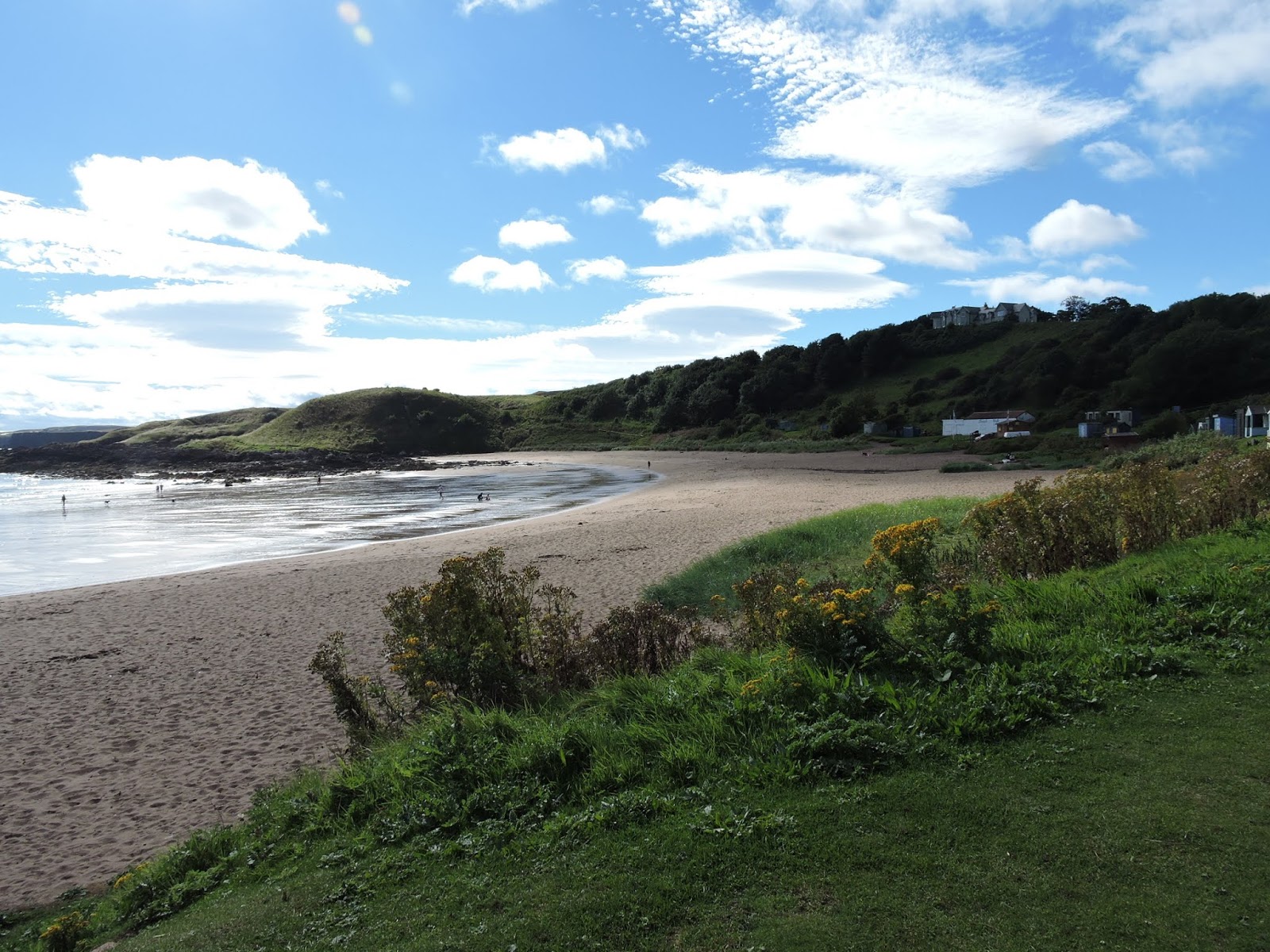
The beach in October


Autumn has its benefits.
A time of reds, yellows and pinks colouring the butterflies, fungi, and berries... and skies that look as if they've come from a Turner painting.


The tourists have gone and we have our beach back to ourselves. The terns have left on their long migration southwards so we will miss their swooping flights over the bay with the sudden dip to take a fish as neatly as swallow taking an insect on the wing. They really deserve the name sea swallows.


There must be fish, probably mackerel, shoaling off shore. 
We have been visited by a pod of dolphins and the gannets are giving their usual display of high diving as they plummet down like daggers into the waves.


The refraction caused by the change from water to air must mean that the birds have to work out instantly where their target will be as they enter the sea rather than just where it appears to be when they spot it from above....and they do it over and over again.

There was an immature bird fishing among its elders. In its first summer, it hasn't achieved the wonderful white plumage of the adult birds.
I read somewhere that the white feathers of seabirds such as gannets and terns that dive for food is an advantage as it camouflages them against the sky and makes their approach difficult for fish to spot whereas birds that swim down to fish like shags, cormorants and guillemots don't need this and are dark.


It seems to make sense.
On that basis, the dark colouring of the young gannet would make life harder but as a result would make it even more important that it burnish its diving coordination skills which would last throughout its quite long life. Evolution is a subtle process.

Saturday, 22 September 2018

Equinox

The autumnal equinox is upon us. 
 At about 2.54 am the sun will be directly over the equator, night and day will be of equal length and we will enter into autumn.
The equinoctial gales have made their presence felt by scattering the apples over the lawn and breaking some of the more heavily laden boughs.


Kilos of windfalls have been carted off to the cider makers in exchange for last year's cider and the bigger branches sawed up to dry out for the stove come winter's chill.

Some clung on  even as the branch broke

The autumn crocuses have survived the blast as has, surprisingly, the delicate Harvest Lily.


The swallows are long gone
We await the arrival of the fieldfares and redwings and have left enough of the windfalls for them.


Bruised and starting to rot, these are a magnet for the butterflies, the red admirals in particular, now that the storm has passed and the sun is warming their wings again.


The harvest moon is almost full... a day or two to go.
The hairst, the Scots for harvest, is done. The fields have a shaved look with their designer stubble already being ploughed under.
The year has moved into a new phase.

Friday, 7 September 2018

The Dowie Dens o' Yarrow


The Yarrow Flower

The Dowie* Dens of Yarrow, the river of sorrow, the valley of romance, of honour, of vendetta and feud, a valley that always stirs the imagination.
Only the stones remain from centuries of conflict, the silent stones.
The winding road runs alongside the river, the eponymous yarrow flower grows in the verges, the land is largely empty, given over to sheep and forestry but once, it thronged with farmers, warriors, huntsmen, lords and knights, reivers, raiders and thieves. Kings visited to chase deer and later to enforce their laws and appoint wardens to maintain them.
Much has been made quite properly of the depopulation visited on the Highlands of Scotland by "the clearances" but the Lowland clearances that emptied these valleys have often been overlooked.
 Long gone are the days when John Murray, the Outlaw Murray of the ballads, could...

keepis five hundred men... a royalle companie.

or even the eighty to a hundred horsemen raised by Scott of Buccleugh in the raid on Carlisle to rescue William Armstrong of Kinmont recounted in the ballad Kinmont Willie.
Now, only the sheep graze where once the people of the valley flourished. The villages of Yarrow and that of Ettrick that took their names from the neighbouring rivers have almost disappeared.
Yet the stones remain, From Neolithic standing stones to Iron Age marker stones and medieval towers, they stand mutely, keeping their secrets to their lichen covered hearts.

My trip took me past Foulshiels, the lowly cottage where Mungo Park, explorer of the Niger was born and on, past the standing stones with their evocative names, the Warriors Rest, the Glebe stone, the Yarrow stone.


The Warriors Rest, The Glebe Stone and The Yarrow Stone


The last of these, the Yarrow stone, is inscribed with the names of Nudoss and Dumnogenos, sons of Liberalis, princes of the Damnoni, the Strathclyde Britons, killed in battle with the invading Angles.
It is probably a reworked neolithic monument as the whole area seems to have been a religious site from earliest times with many burials.


Pressing on to Craig Douglas, I paused at the farm once occupied by James Hogg the poet and writer. It was the site of the Douglas tower destroyed on the orders of James II in 1450. Legend has it that it was the site from where the lovers eloped as recalled in the ballad The Douglas Tragedy, only to be caught at the Douglas stones further up the valley where the duel to the death of brothers and lover occurred.

He's mounted her on a milk-white steed
And himself on a dapple grey,
With a bugelet horn hung down by his side,
And lightly they rode away.
Lord Willam lookit o'er his left shoulder,
To see what he could see,
And there he spy'd her seven brethren bold,
Come riding o'er the lea.
The brothers and father do battle with Lord William, the brothers are slain and the father wounded but William sustains a mortal wound and dies in the maiden's arms.

Lord William was dead lang ere midnight
Lady Marg'ret lang ere day-
And all true lovers that go thegither,
May they have mair luck than they!
Lord William was buried in St. Marie's kirk,
Lady Marg'ret in Marie's quire;
Out o' the lady's grave grew a bonny red rose,
And out o' the knight's a brier.
And they twa met, and they twa plat,
And fain they wad be near;
And a' the world might ken right weel,
They were twa lovers dear.
  

The Bught Stones and the The Douglas Stones, ancient stone circles said to be the site of the fateful
affray, are now densely covered with conifer forest and, try as I might, I couldn't find them. That will be an expedition for another day


Blackhouse Tower
A later peel, the Blackhouse Tower still guards the path by the Douglas burn taken by the fleeing lovers.

St Mary's Loch

Further on towards St Mary's kirk, the kirk o' the forest, and the scenic St Mary's Loch, I passed Dryhope Tower, birthplace of Mary Scott, the Flower of Yarrow and wife of Walter Scott of Harden from whom Sir Walter Scott claimed descent. This redoubtable lady was alleged to have served a dish of spurs on a salver to her reiver husband indicating that times were hard and he needed to go raiding again!

Dryhope

Passing the loch and the kirk, I turned up the Megget Water, tributary of the Yarrow and passed the grave of Piers Cockburn, knight and reiver, hanged for his crimes by Royal Warrant at his castle door. Forever remembered in the ballad The Lament of the Border Widow, the story of Cockburn's demise has been romanticised to fit in with the old predictions and tales. The reiver was, in fact, executed in Edinburgh after due process of law. Still, it makes a good story in an evocative setting.


From Cockburn's tomb the road winds up past the Megget reservoir which flooded the valley and submerged the castle tower of Cramalt, long the hunting lodge of the Stuart kings. In The Bridal of Polmood, James Hogg that assiduous collector of ancient tales, describes how four hundred men would assemble to drive the deer " with hound and horn" to the archers on Hunter Hill behind Cramalt


Cramalt tower
  There is a facsimile of the ground plan of the old tower on the banks of the reservoir but the deer have long been replaced by sheep and the forest is no more.

Sheep not deer


The climb took me up to the watershed between the Megget and Talla waters running east and west respectively. Here, I found the Megget Stone. Perhaps it was a boundary marker between the Iron Age tribes, the Selgovae and the Novantae or maybe from even more remote times when these valleys were full of people with traders and farmers exchanging goods and produce at fixed points recognised by all.

The Megget Stone
 
The empty Megget  Vale

If only these stones could speak and show, what tales they would tell

*dowie  is  Auld Scots for sad or sorrowful

Tuesday, 26 June 2018

Meanwhile....nearly fourteen hundred solstices later...


Another solstice. Another year half gone. A thick bank of cloud obscured the horizon so the actual sunrise, the appearance of the sun between sea and sky, could not be seen clearly.  Would that have been significant to those watchers, thousands of years ago, for whom the solstice was one of the great turning points of the year? How would they have interpreted it?
Interpreting the past is always difficult if not impossible.   We are digging in the field next to the ruins of our Benedictine priory, seeking some evidence of the original Anglo-Saxon church of St Aebba, the bringer of Christianity to the peoples of the area, the remnants of the Goddodin who were defeated in their battles against the incomers and absorbed into the rising power of Northumbria.
The field has been screened by metal detectors, dowsed, and scanned by geophysical radar devices. There are signs of previous occupation but, of course, Aebba's church will be under the later 12th and 14th century buildings.  It would be nice to find some evidence dating back to the 7th century or, at least, to Anglo Saxon times.


Trenching and trowelling is hard work and finds are rare and disappointments are common.
Very early on, a piece of "ceramic" just leapt out at me but, despite its appearance, it turned out to be just an unusual stone,  Oh well, scrape some more earth into a bucket. 


Disappointment - just an unusual stone


Stuff is now appearing, some ceramics, animal bones, lots of animal bones. Maybe we are excavating the priory abattoir.   Next week there are some deeper layers to explore so who knows what will surface.

Medieval pottery

The vallum, the outer perimeter earth bank of the monastic site is becoming evident and we are getting deeper into the history.
 As I scraped away at the in-fill of ditches, I wondered about the ordinary folk given this new religion, probably on the command of their ruler who would have no wish to offend Aebba, the sister of the powerful King, later Saint, Oswald of Northumbria. Did they still get up to see the sunrise at the solstice and offer a prayer to their old gods?    After all, we still touch wood for luck, throw salt over our shoulder and say good morning to magpies.  Old habits die hard.


Saturday, 16 June 2018

Bloomsday


Dublin Bay and Martello Tower

June the sixteenth, 16th June, Bloomsday. A day to celebrate the meeting on that date in 1904, of James Joyce and Nora Barnacle, a young Galway lass working as a chambermaid in Finn's Hotel in Dublin. 


They walked on the beach at Sandymount. Within a few months they had run off together to Europe and she remained his partner and his muse for the rest of his life. His gift to her was to immortalise that day as the single day in which the entire action of his masterpiece Ulysses takes place from one side of Edwardian Dublin to the other.

This year there was no need to go to Dublin to re-enact the scene of Bloom feeding the seagulls at the O'Connel Bridge. There are herring gulls nesting on the highest chimneys of the house beyond the reach of all attempts at dislodgement.


Bloomsday visits have been to what is still very recognisably the city Joyce knew, have been greatly enjoyed in the past but this year I'll have to be satisfied with listening to a download of the BBC dramatisation of the novel and the glass of burgundy with gorgonzola cheese of Bloom's lunch at Davy Byrne's pub. ( It was Stilton that was available but it's all blue cheese)


Davy Byrne's pub


A breakfast of fried pork kidneys would have been a bit to much!

Joyce's stream of consciousness writing, recurrent themes, symbolism and parallels with Homer's original make for re-reading of the novel again and again. Every time, another jewel surfaces from the prose like gold in river gravel.
We followed the trail of Homer's Ulysses through the Mediterranean last summer (Blog 27 /10/17 ) Maybe next June we'll go back to Dublin and trace the paths of Joyce's heroes again.