Sunday, 20 March 2016

"...the chapel fair of Tillmouth upon Tweed" *

* Marmion Canto VI
   Scott


The medieval Twizel Bridge over the Till

Today,  the 20th March is the day St Cuthbert is reputed to have died in 687 on Lindisfarne.

After walking the St Cuthbert's Way last year, (Blogs 15/5/2015 to 23/07/2105), I am easily lured by any place with the saint's name attached and there are so many to choose from. The number of chapels and sites where his body is said to have rested on his travels around what is now Northumberland, Yorkshire, Lancashire and Southern Scotland numbers at least fifty, not counting his final resting place at Durham.
When the Viking raiders attacked Lindisfarne two hundred years after his demise, the monks exhumed the body which was said to be uncorrupted, evidence of his sainthood.
They set off to carry it to safety and for the next seven years journeyed around the kingdom of Northumbria as it then was – as far north as Mailros (Melrose) where Cuthbert had first become a monk, as far west as Whithorn where his mentor Aidan had studied and as far south as Ripon, the monastery of his contemporary, St Wilfred.
Later examination of the remains of the saint suggest the body had been mummified.
The extent and duration of the travels throughout the land suggest another purpose for the journey of the saintly corpse than merely to escape the depredations of the Norsemen.
 A cult figure in his lifetime and a venerated saint afterwards, he served as a symbol to rally the, by then Christian, peoples of the kingdom of Northumbria against the pagan Norse.

Where the River Till joins the Tweed stands St Cuthbert's chapel.


St Cuthbert's Chapel, Tillmouth


What is there today is an eighteenth century folly but it stands on the site of the medieval village of Tillmouth. The village is long gone save for a few crop marks seen on aerial photos but there was a chapel of St Cuthbert here in 1311 and legend has it that his remains were floated in a stone coffin down the Tweed from Melrose and came to rest at Tillmouth


An extract from Hutchison's 1823 edition of  HISTORY & ANTIQUITIES OF THE COUNTY PALATINE OF DURHAM  reads

On a peninsula formed by the confluence of the rivers Till and Tweed, was an ancient chapel, on the side of which, about five years ago, (1794) Sir Francis Blake built a small chapel; the windows of which some wanton and sacrilegious villains have lately destroyed. About thirty yards to the west of this place, and fifteen from the Tweed, lie the remains of a stone boat or coffin, in which, tradition says, the body of St. Cuthbert was miraculously conveyed down the Tweed from Mailross. By some hydrostatical experiments whilst it was entire, we are informed it was proved that it might float with the remains of the saint *.
 Mr Gough, in his Additions to Camden, says, that it " is a stone boat, of as fine in shape as a boat of wood." We confess we did not examine the parts so narrowly, being prejudiced with the idea, that they were the mere fragments of a stone coffin. The dimensions of the present remains of the boat are— 
In the inside, length 5' 0"  Breadth at top 2' 0'' Do. broadest part 3' 2''. (One end is broken off, and has been taken away.)Do. where broken off. 3' 0'' Height of the sides 1' 3''|Thickness of sides and bottom 0'4'' 
* From this data, it is probable, that the outside length of the boat when entire,was nine feet three inches—its mean outside breadth three feet three inches—the height one foot nine inches—and the circumference twenty one feet. From thence, it is calculated, that it contained nearly twenty cubic feet uf solid stone, which, by reckoning the specific gravity of freestone, 2,5. it would weigh 31251b. and its outside dimensions would displace 52,6. cubic feet of water, which. at 62lb. and a half to a cubic foot, would be 32871b.—therefore, from 32871b.weight of water displaced, take 31251b. weight of boat, leaving 1621b. for  the boat to carry, which is equal to that of a man near twelve stone weight. 

So it seems that the saint in his stone coffin could have floated down the Tweed ! 

 There is another legend that a local farmer took the broken stone coffin away to use to salt pork. Now that sounds genuine!
The spot where the Tweed receives the Till, its only English tributary, is peaceful and even if the legend is untrue, it didn't detract from the enjoyment of watching goosanders fishing in the junction of the waters.
Goosander

Goosander ducks and drakes at the rivers' junction

On the way home, I remembered the stone coffin in the ruins of the 14th century Priory in our village and went to measure it
Stone coffin at local Priory
It is about the same size.  I wonder if  Historic Scotland would let me see if it floats?

Wednesday, 16 March 2016

Easing the spring


The first warm day of Spring made clearing up in the garden less of a chore. When sunshine seems like a treat after the cold and dark of winter, the enjoyment is heightened. Living in constant sunshine might have its advantages but, like a diet of ice cream it would dull the senses. You can only know comfort if you've been uncomfortable, food always tastes better if you're hungry. The sunshine is appreciated by every denizen of the garden. The wood mouse that lives in the hedge and was last seem gathering seeds fallen from the bird table in Autumn, has reappeared and is back scavenging in the same spot no doubt hungrier and leaner after his winter sleep.


The most pleasing sound was the hum of honey bees foraging among the snowdrops. The solitary bees don't produce the same intensity of sound as their social cousins. It is the perfect sound to welcome the sun.

They winged back and forward from flower to flower seemingly at random with their orange saddle bags of pollen.

The thrushes are back singing their double song and trying to compete with the bullying of the blackbirds. Where do they go in the winter? The blackies hang around eating the windfall apples and getting hand outs of meal-worms but the thrushes disappear or so it seems. They are shy at the best of times so it is just the absence of their song that catches the attention. 


Where's my meal-worms?

The sound of the bees stirred a memory of a line from a poem read at school and probably not appreciated at the time - "easing the spring" from Henry Reed's "The naming of parts ".


And this you can see is the bolt. The purpose of this
Is to open the breech, as you see. We can slide it
Rapidly backwards and forwards: we call this
Easing the spring. And rapidly backwards and forwards
The early bees are assaulting and fumbling the flowers:
They call it easing the Spring. 

Funny how a single sound or scent or tune can bring to mind something that seemed long forgotten.


*


Friday, 4 March 2016

Bridging the gap

After my morning swim, I hauled myself out of the water by my fore limbs on to the pool-side, the land if you like to call it that....just like my tetrapod ancestors did 350 million years ago...and not too far from where I did the same thing this morning.
A few miles from the swimming pool, palaeontologist Stan Wood discovered fossils that revealed the process when vertebrate life forms moved from the seas to the land. True, Scotland then wasn't quite where Scotland is now. It was a good bit south of the equator and part of a land of shallow seas, lagoons, coastal flood plains and tidal mudflats. 
These have given us sandstone, mud-stone and cement-stone deposits along the Whiteadder river at a spot eponymously named Willie's Hole, a deep pool below a natural weir.
The river bed and the local sea cliffs have both yielded specimens of great importance so I just had to go and take a look.


Layers of sedimentary rocks along the river bank


It made for a pleasant stroll along the river bank with alder carrs and mallards for company and a walk back over 350 million years

Willie's Hole


It was here that the fossils were found that bridged the so-called Romer's gap, the "gap" in the fossil record from water dwelling tetrapods to land dwelling forms. The gap is named after the man who first noted the problem.

A small but fully explanatory exhibition of the fossils at The National Museum of Scotland outlines the finds and their significance.


Why the four limbed terapods hauled themselves on to the land isn't yet clear but they did and they breathed air and that is why I was breathing air and hauling myself out of the water millions and millions of years later.

What our tetrapod ancestor may have looked like


The tetrapod fossils from before 345-360 million years ago showed creatures with four limbs that were not strong enough to support them on land and those after Romer's gap were well adapted to life on land, the ones from Willies Hole show the development of a ribcage and limbs strong enough to make the transition. I really appreciate the effort they made!


Monday, 29 February 2016

An East Lothian stroll


Sunshine on a frosty spring morning, perfect for wee ramble round East Lothian and a climb up Traprain Law where the legendary King Lot, who gave his name to the Lothians, had his capital.
It was certainly the oppidum of the Gododdin, the Votadini to the Romans and the "Men of the North" in the Welsh poem - Y Gododdin. 

 They marched south to the aid of their Brythonic kinfolk, the proto-Welsh tribes, fighting to  repel the Anglo-Saxon invaders and, at Catterick in Yorkshire, were utterly defeated.

Men went to Catraeth, swift was their host.
Fresh mead was their feast, their poison too.
Three hundred waging war, under command,
And after joy, there was silence.
Three hundred gold-torqued,
warlike, wonderful
Three hundred proud ones,
Together, armed;
Three hundred fierce horses
Carried them forward,
Three hounds and three hundred,
Sad, they did not return. 

 
Their land eventually became part of the Anglo-Saxon kingdom of Northumbria but the ramparts of their citadel can still be seen on the hill top.


Iron Age earthwork
A slippery climb up the north side of the hill where the sun had still to reach the frosty ground was well worth the effort for the view from the summit across the Firth of Forth from Berwick Law and the Bass to the snowy Grampians in the distance.

The rocky plateau has a trig point and a wee lochan and, at the east end, an outcrop split in two millennia ago by glaciation into the Mother Stone and the Maiden Stone.
 Squeezing between the two is supposed to ensure fertility !
The Mother Stone and The Maiden Stone

A cautious descent to the road and a stroll to Hailes Castle seemed like good idea.

So, directed by a old finger pointing sign post, I set off.  
Haddington - 5/8ths of a mile!


The mighty "fortalice of Halis" withstood attack by Harry Hotspur in 1400 prior to his victory against the Scots at Homildon Hill as recounted by Shakespeare in Henry IV


Young Harry Percy and brave Archibald,
That ever-valiant and approved Scot,
At Holmedon met,
Where they did spend a sad and bloody hour,
As by discharge of their artillery,
....
The Earl of Douglas is discomfited:
Ten thousand bold Scots, two and twenty knights,
Balk'd in their own blood did Sir Walter see
On Holmedon's plains.

It is still plain to see how Hailes withstood  Hotspur's assault. With its mighty 13th century curtain wall and ditch to the front and the river Tyne behind, it must have represented a formidable challenge to any attacker. A fortified water-gate allowed access to the river so a siege would have been difficult and prolonged. It still impresses with its sheer strength and solidity.

The wall above the river

The West Tower

The Water Gate

From the Bronze Age to the Union of 1707, these fortresses of Trapain and Hailes dominated and guarded the coastal plain from Dunbar to Edinburgh where the AI now roars, unimpeded and mindless of them.

Traprain Law from Hailes

...and nobody measures their journey to 5/8ths of a mile!

Thursday, 25 February 2016

Madness or Moonshine


The recent full moon was the Lenten Moon or the Snow Moon as the Americans call it and, true to form, there were a few flakes drifting down this morning but they soon vanished with the sunshine. The cold bright sunlight has brightened the post winter gloom and Spring does seem on its way. 
The aconites, snowdrops and crocuses are out as are the hellebores.
The Christmas Rose (helleborus niger), the earliest of its kind is past now but the Lenten Rose (helleborus orientalis) is in full flower.


Poisonous, its name means "harmful to eat", it has many legends surrounding it. In witchcraft, it is used to summon demons. In Greek mythology it was used to save the daughters of the king of Argos from madness and was supposed to have been used to poison Alexander the Great. That such a delicate flower could be so toxic and yet so appealing makes one reflect on the nature of things.


Full moons are supposed to induce madness or lunacy though scientific evidence seems to suggest that this is all moonshine... unless you are a werewolf!
 There is still something bewitching... there's that magic word again...about full moons.

The next full moons will be the Egg Moon in April, the Milk Moon in May and the Flower Moon in June......and in May there will be a Blue Moon but that's another story.
As Lent approaches, what will I give up?
 Not moon-watching anyway.


Tuesday, 2 February 2016

Painting the clouds with sunshine


Pre-dawn

Up early this morning to try and catch a sight of the "dance of the planets" Five of the planets are to line up across the sky just before dawn all this week from Jupiter, up near the brightest star Arcturus, to Mars, Saturn, then to Venus and finally, Mercury low on the horizon. Hopefully the clear skies will hold until the weekend.

 Waxing Gibbous Moon


The stars were bright enough to overcome the light of a gibbous moon so the planets could be picked out.  Jupiter big and bright, Mars dusky red, Saturn  difficult to spot and Venus clear as ever. Clouds low on the horizon obscured Mercury.
The fiery red dawn heralded another rare phenomenon, a mother-of-pearl sky or nacreous clouds.


High in the stratosphere they didn't move but shone, vivid and iridescent for an hour or more until the rising sun dispelled their magic.


  The camera, at least, my camera didn't do it justice.  Truly worth getting of of bed early to witness.

Monday, 18 January 2016

Winter visitors


Winter has come at least in part to the village. The moors are covered with a dusting of snow and it has turned cold enough to bring the blackcap to the bird feeders. Loth got a surprise when a sparrow hawk, so intent on snatching a meal from the garden birds clustering round the peanuts that it didn't swerve in time, clattered into one of the kitchen windows. leaving a ghostly silhouette of outspread wings on the glass.
The next day I saw a kestrel hunting like a sparrow hawk. Instead of hovering in the freezing wind, it was skimming along in the lea of a drystone dyke no doubt looking for voles or mice in much the same way as a sparrow hawk patrols the hedgerows for unwary tits and sparrows. 

Greylags
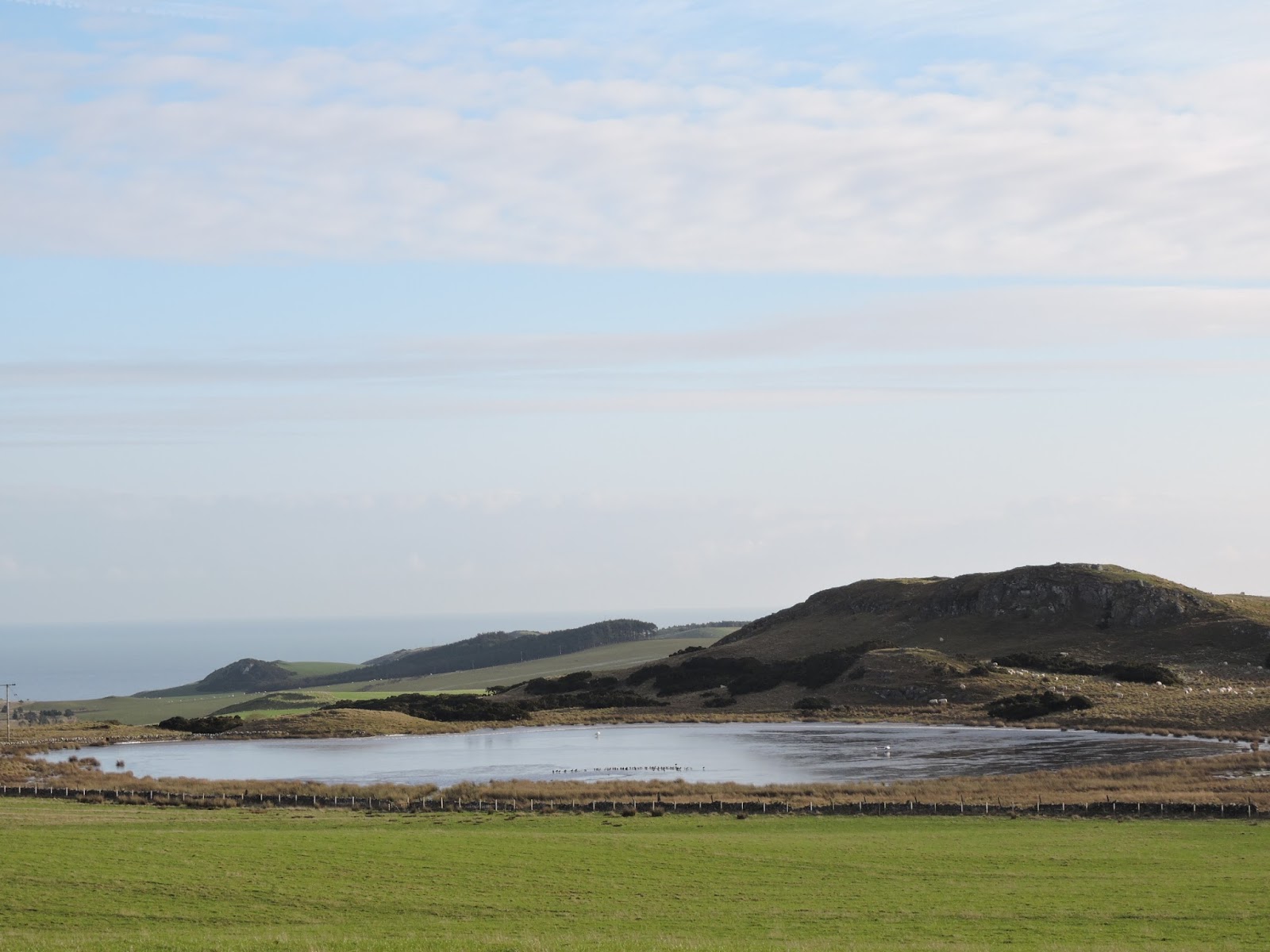
The wee lochan beneath the Lowrie Knowes - the Hillocks of the Fox in auld Scots - has its usual quota of winter visitors. There were whooper swans and grey lag geese along with a small flock of wigeon paddling around in the decreasing circle of open water as the ice crept across the surface.


Whoopers, wigeon and coots  sharing the small patch of open water

There seem to be an increased number of snipe and jack snipe presumably due to winter migrants but no sign of the large flocks of fieldfares and redwings that were a feature of previous winters, possibly due to the enthusiastic tidying up of the local hedgerows with scarcely a haw or a berry left on the clipped bushes.
Along the sea shore, a golden eye and a diver were seen fishing among the kittiwakes and the shags, The diver was too far out and too elusive to be seen accurately but it might have been a red throated diver. It looked smaller than our usual resident, the great northern.
All in all, its nice when old friends call back.