Friday, 27 June 2014

Invasion


Inveresk village with its 17th and 18th century houses and beautiful gardens is one of the finest conservation areas in Scotland.


Gardens to delight the senses are stocked with plants from every part of the world.


The stones that made the garden walls and the old houses are from still older buildings as far back as the Roman town.  There are no ruined stones only ruined buildings and good stone will always find a home... or make one


It has not always been the place for tranquil contemplation. Situated on a ridge commanding views of the Forth and above the point where the Esk river meets the Firth of Forth – Inbhir Easg , the confluence of the river Esk, with the Forth, in Gaelic – it was of strategic importance on the coastal plain.

It was occupied by the Brythonic tribe, the Goddodin who, no doubt, had displaced the earlier inhabitants. When the Romans invaded and marched north, its significance was obvious to them and they established a large fort and, later, a vicus or township. The Goddodin, latinised toVotadini became a client state of the empire at its northern frontier, at the eastern end of the Antonine Wall.


Diagonal chisel marks of Roman stonemasons
 on the walls of the church


When the legions left, the land was disputed by Northumbrian Angles and Southern Picts. By the time the country had melded into the nation of Scotland, the invading English armies took the same route north.

The land around St Michael's Kirk had great mounds to take artillery batteries guarding the old bridge and port.
The Rough Wooing of 1547 when Henry VIII tried to force a marriage between, the infant Mary, Queen of Scots and his son Edward, had the English armies devastating the area and defeating the Scots at the Battle of Pinkie Cleugh.

Pinkie Cleugh  Battle Site

The seventeenth century saw Cromwell's Roundheads take possession and the eighteenth saw the arrival of Charles Stuart's Jacobites

Invaders and invasions have come and gone, none have possessed the land but fleetingly. All have retreated and left. But now there are more persistent interlopers.


The plant invaders – Japanese knotweed, Himalayan balsam., Giant hogweed.   More demanding and more dogged than any Roman, Anglo-Saxon or Englishman, they have colonised great tracts of the country, subduing and displacing the natives. These invaders are here to stay it would seem.

Himalayan Balsam

Japanese Knotweed


Napoleon called us a nation of shopkeepers – he didn't manage to invade either – but it is because we are a nation of gardeners that we suffer under the alien intrusions. Plants brought back to Victorian gardens have commandeered great swathes of riverbank overpowering all in their path.

It looks like these invaders have succeeded  where all others have failed. They are the possessors of the land now.


Saturday, 21 June 2014

Feeding the gulls in Dublin

June 16th - Bloomsday – the day that is forever associated with James Joyce's Ulysses. The day he met,  in Nassau Street, Nora Barnacle, chambermaid at Finns Hotel who was to become his lover, wife, life-long companion and muse.


 Ulysses, the novel - though that is scarcely what it is - takes place over that one day in Dublin in 1904.
Joyce's Dublin is still there despite the changes and you can follow the paths taken by his two protagonists as they make their way from opposite sides of the city and eventually, by chance, meet in the Holles Materrnity Hospital.
 The solicitous Leopold Bloom is enquiring of a woman he knows who has been three days in labour while the impetuous Stephen Dedalus is getting drunk with the medical students.  Having met Stephen's father at the funeral of Paddy Dignam, Bloom's concern for young Dedalus is such that he later rescues him from a beating by two soldiers in Bella Cohen's bordello.

Last year, we made our way in from Dalkey where Joyce / Dedalus taught at school and lived in a Martello tower, following him on his  day off  into the city to the National Library.
(Blog 6th April 2013)

Eccles Street

This year we came from the north of the city from Eccles Street.  No.7, the home of Bloom and his unfaithful, but loving. wife Molly, no longer exists but the rest of the Georgian frontage with the fanlights over the doors, is still there.


49 Lower O'Connel Street - Lemon's shop sign is still there

In O'Connel Street, you can still see Graham Lemon's sweet shop - “a sugar-sticky girl shovelling scoops of creams for a  christian brother. Some school treat.”, where Bloom is given a free newspaper – a throwaway - which gives rise to much misunderstanding and malice.
 A twenty-to-one outsider called Throwaway did win the Gold Cup in 1904.
The racing mad populace of the Dublin pubs think he has backed the horse and resent him for it but Bloom is quite unaware of it all.
We followed his meanderings around the city centre before and after the funeral - the shops, pubs, meeting places, offices and public places of Joyce's remembered city.

 Joyce left in 1904, ran off with Nora, and only returned briefly on four occasions, the last in 1912.
Although the Dublin of 1904 is the setting, the themes, thoughts, connections, literary and mythological links, symbolism, and archetypes found in Ulysses are universal and timeless.  It could be set in any city in any country yet because James Joyce wrote it, it had to be and still has to be, Dublin in 1904.


Davy Byrne's pub is still as popular as it was in Joyce's day.
Bloom muses...
"Moral pub. He doesn't chat. Stands a drink now and then . But in a leapyear once in four. Cashed a cheque for me once".
 After a glass of wine there, he continues his perambulations around the Dublin streets.
 He feeds the gulls with a couple of Banbury cakes bought from an old woman's stall for a penny.


We couldn't get Banbury cakes so had to make do with croisants – three for 2 Euros!

 Further down Bachelors Walk, the Ormond Hotel, where he had a late lunch in the back room to avoid meeting his wife's lover, Blazes Boylan, is sadly dilapidated.
Ormond Hotel

Mabbot Street, the entrance to “Night-town”, the red light area where Bloom and Dedalus end up is still there if now thoroughly respectable.  The site of Bella Cohen's house of ill repute seems to have become the glass fronted tower of an asset management company, but then Bella was just managing her assets in 1904.

Mabbot Lane

Joyce's Dublin cannot survive for ever but with careful planning and preservation, we should be able to follow Bloom, Molly, Blazes Boylan, Stephen Dedalus, Buck Mulligan about their city for years to come......and feed the seagulls at O'Connel Bridge.

Friday, 13 June 2014

A day of enlightenment and a question


 LotH was battling with the soft furnishing departments of the Edinburgh stores so I withdrew and  took the opportunity to visit a place I had always meant to go but, because it is so easy to  reach, had never done so.

Hailes Castle in East Lothian


Hailes Castle was the home of the Dalrymple family so, when David Dalrymple purchased the Palladian mansion near Musselburgh from its architect, James Smith, it became New Hailes and, eventually, Newhailes.

It typified the move of the Scottish aristocracy from the tough defenders of embattled strongholds against both local and cross-border attackers in various combinations and alliances, to cultivated men of educated tastes and interests. 


Newhailes

 The Union of the Parliaments and the creation of Great Britain in 1707 created a peaceful environment for learning to flourish and led on to the phenomenon of the Scottish Enlightenment

In Scotland, the wide base of literacy, and a collaborative spirit among the key thinkers of the day, meant that when world class philosophers emerged, their ideas were taken on board, developed, and - most importantly - applied by others whose interests ranged from economics through medicine, engineering, geology, law, archeology, physics, chemistry, biology, history and more. The result was astonishing and has since been described as the greatest outpouring of intellectual and scientific accomplishment seen in any nation at any time in history.

New Hailes and David Dalrymple, the 3rd Baronet were part of this great interaction of enquiring minds. The library with its huge collection of books was described by Samuel Johson as “the most learned drawing room in Europe”

The Library now denuded of books

The gardens and grounds were designed to stimulate the senses with outstanding views and specific features added such as the grotto which was associated with thought and contemplation. The poet and satirist, Alexander Pope, had a grotto dug at his Palladian villa in Twickenham.


The Shell Grotto

A more mundane tunnel was excavated at Newhailes to allow servants access to the house from their separate quarters without the upper classes having their contemplation spoiled by the coming and going of the lower orders!
The walkways and viewpoints are still there but the hoi polloi now have the freedom to roam the paths and the views have been somewhat marred by the march of progress.


The chimneys of Cockenzie power station providing a different sort of enlightenment for the masses

The spread of ideas from the philosophic to the practical with the work of Hutton in geology: Black in chemistry and physics: Cullen in medicine, chemistry and agriculture: Watt in steam engineering: Murdoch in gas lighting; Walker in natural history, resulted in changes in society that those who inspired them could never have foreseen.

The windows of the great library, and many others in the house are now blind, mainly as a result of internal alterations. Somehow they seem symbolic of the intellectual blindness that followed that most glorious time when the Enlightenment finally succumbed to religiosity and romanticism.

Blind windows

 Would that eighteenth century outpouring of  philosophic and scientific thought that came to be known as the Scottish Enlightenment and that influenced western society to this day, have happened without the Act of Union?       We will never know.

Monday, 9 June 2014

Beinn Bragar and beyond


Beinn Bragar

Beinn Bragar isn't much of a hill, less than a thousand feet, but on the flat Lewis moorland it, and its two companions, Beinn Rahacleit and Beinn Choinnich, stand out as a mini-massif on the peat bogs. The ramparts of ancient stone promised some energetic scrambling with the prospect of some decent views of the coastline to the north and west.

A good scramble!

The path in from Shawbost took me over abandoned peat hags and squelchy mosses to the base of the ben then a stiff but relatively quick, even for an old guy, climb to the upper stony redoubt.
The entire climb was accompanied by the call of cuckoos, perhaps voicing an opinion of the sensibility of the blogger, and the warbling wheep of curlew. The approach slopes were steep enough to keep my face parallel to the ground and gave me a passing inventory of the flora and fauna of the hill - the insectiverous butterworts, spotted hebridean orchids, busy burying beetles, marsh violets and delicate sedges.


The scramble to the top was quite exhilarating and the views, as expected, were beautiful.
To the north, I saw a good track which looked a lot easier than the peat moor that I tramped across and seemed the best way out but, as I discovered, everything has its price.  The descent was not as easy on the northern slopes. 


No easy way down
 Somewhat bruised but intact, I made my way back to have look at the remains of an Iron age fort – a dun,on   the edge of the appropriately named Loch an Duna, in the village of Bragar.

Dun Bragar


Built in the first millenium B.C., it was occupied up until the middle ages when defensive sructures were still essential in the habitual clan battles between Morrisons, Macalays, and Macleods.

Now, the only occupants of the loch are grey lags and mallards, raising their broods in peace.


  Down by the sea, I came across the somewhat grandly named Port Mhor Bragar,  translating as the big port of Bragar which only consists of a slipway but, like so many of the spots on the Hebrides, has an a view round every corner.


Another relic of the middle ages is the pre-reformation chapel, Teampull Eoin, at Port Mhor Bragar.  Like so many of these charming little early churches along the coastline of Lewis, it has been allowed to fall into ruin, despoiled by modern graves dug in its interior.
 Strange that islanders so famed for their religiosity should treat the places of worship of their forefathers in such a cavalier fashion.

Teampull Eoin - St John's chapel


   Despite the bruises, a good day out.


Tuesday, 3 June 2014

In search of the bird with the longest name


Well, not quite the longest – the red breasted merganser beats it by two letters, but the saw-bill is encountered much more frequently than the Arctic visitor, the red necked phalarope, a summer migrant returning to breed in a very few select locations in the northern and western isles.

Loch na Muilne
 Loch na Muilne – the Loch of the Mill- in the north of the Isle of Lewis is just such a spot and my timing for once was spot on.
 The last week in May is when they return to this wee lochan to breed. Unusually for birds, it is the males who are dowdy and the females who sport the bright colours. The Gaelic name is Deargan-allt which translates appropriately as "a red mark on the stream".
Why they choose this stretch of water from the dozens, scores, possibly hundreds of lochans scattered all over the Lewis moors, is a mystery to me. Maybe the combination of vegetation, marsh and shallows, insect species – the micro-environment - suits them. Every other loch seemed to be taken up by greylags and their offspring. Perhaps their absence was the key to the phalaropes choice.


Greylags protecting their goslings
On my first visit, I was just turning to leave when two came flying in and disappeared into the long grass. Not sure, I returned the next morning with no success but, after a day spent scrambling up Ben Bragar, I returned to catch sight of the pair paddling around the margins of the lochan in their curious circling fashion.

Tormentil
Feeling pleased with myself, I traipsed back under the song of skylarks and the incessant piping of oystercatchers, across the moorland studded with wild flowers – marsh lousewort, milkwort, tormentil, the ever present bog cotton and the Hebridean orchid. pausing to admire the drystone building with massive boulders in the ruined black houses and field walls on the way.


Marsh lousewort


Hebridean orchid


Near Loch na Muilne is the Arnol Black House, the Tigh Dubh that was the dwelling of Hebrideans for centuries and had probably not changed much since Neolithic times.
 Perfectly adapted to the climate of the Western Isles and using the local materials to hand, these houses were initially “improved” which actually made living conditions in them worse, then abandoned all together for modern “white” houses.
The black house with its thick double skinned walls, rounded corners to deflect the gales and replaceable thatched roof, housed the family at one end and their cow at the other. A handy arrangement in the long, cold, dark Hebridean winter.

Arnol Tigh Dubh

Steps were built into the drystone walls allowing access to the roof for repairs, the rain running off the thatch drained through the rubble filled walls, leaving the interior dry and the smoke from the central peat fire kept the thatch dry as it found its way out. Primitive but effective.

Interior with peat fire


An effective gateway for bipeds but not quadrupeds!
People were most likely living in similar houses when they erected Clach an Trushal, the Trushal stone as part of a lost stone circle, 5000 years ago.


Were the rednecked phalaropes flying in to breed on Loch na Muilne then?


P.S.  A special thanks to the people at the cottage near the Trushal stone who found and looked after the camera that the dopey blogger left behind.

Sunday, 18 May 2014

" and be a nation again" ?........The Battle of Dun Nechtan 20th May 685..


Not blue woad but green alkanet which gives a red dye

This year is the anniversary of the Battle of Bannockburn, 1314 and we are to vote on the status of Scotland as a country.
 In a few days, on the 20th May, it will be the anniversary of a much older battle, one that decided if the country now erroneously called Scot-land would exist at all...and it wasn't fought by the Scots.
In 685, the Scotti were a small enclave on the west coast called Dal Riata, an extension of their native kingdom in present day Ulster. They had been comprehensively defeated at the battle of Desgastan (possibly Dawston in Liddesdale) in 603 by the might of the regional super-power, the Anglian kingdom of Northumbria.
The Brythonic people of southern uplands, the Gododdin, had long been subsumed into the Northumbrian kingdom, a decline hastened by their disasterous support of their southern cousins from Wales against the all-conquering Angles.
Oswiu, the Northumbrian monarch, had extended his domain northwards into what was the land of the Picts
Bede records that “ Oswiu subjected the greater part of the Pictish race to the dominion of the Angles” He installed puppet rulers and controlled the kingdoms of the Britons of Strathclyde and the Scots of Dal Riada as well.
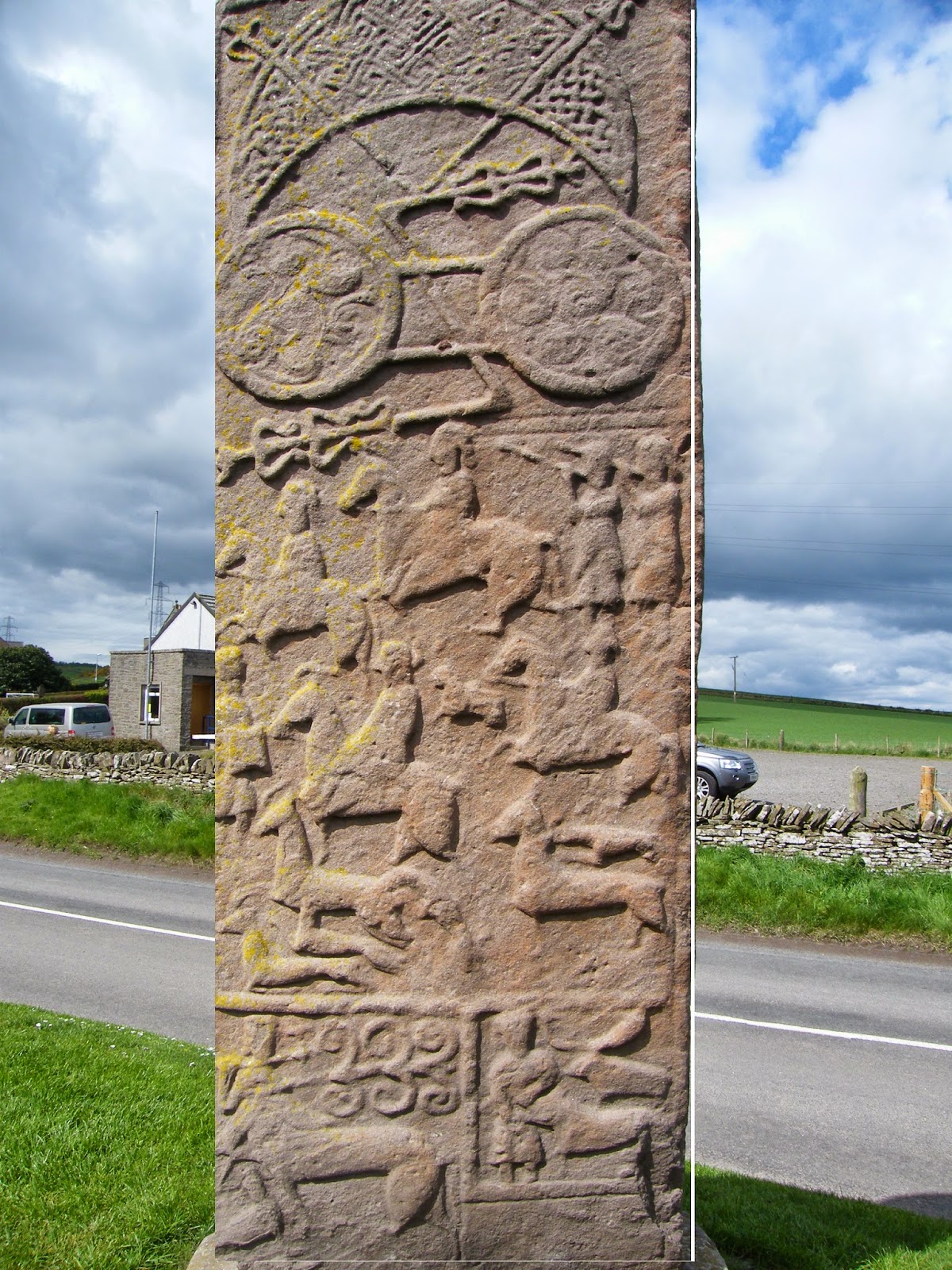
Aberlemno stone showing a ? hunting scene
The power of Northumbria grew unchallenged in Northern Britain.
Oswiu's death in 670 and the succession of his son Ecgfrith created an opportunity for the Picts. They rid themselves of the Northumbrian vassal king and rose in rebellion in 672. Ecgfrith was furious and savagely crushed the revolt with his army of horsemen on the plain between the rivers Carron and Avon. This is the first record of cavalry being used in British history.
It took twelve years for the Picts to recover under their new king, Brudei or Bridei mac Beli, in the lands north of the Tay.
Given the hostility between the two nations and their cultural and ethnic differences, it is a strange quirk of history that the kings, Ecgfrith and Brudei, were cousins. Due to dynastic marriages made by earlier Northumbrian kings, in more peaceful attempts to control the north, they shared a common ancestor in Aethelfrith of Northumbria.
How history repeats itself or, at least, the desire for military conquest among rulers does. Was not the appalling conflict of 1914 called “the cousin's war”?

Remembering the cavalry and the slaughter of 672, the Picts avoided pitched battle in 685 and feigning retreat, lured the Northumbrians into their trap at Dun Nechtan, also known as Nechtan's Mere or  Lin Garan “the pool of the Heron”. The site is usually taken as Dunnichen Moss, a marshy area beneath a fortified hill-top near Aberlemno in Angus. The marsh ws drained in the ninetenth century but appears on old maps.
The Northumbrians were comprehensively defeated and Ecgfrith slain.
 His body was taken to Iona, the resting place of Pictish kings where Brudei himself was laid to rest some eight years later.


 The power of Northumbria was broken north of the Forth and the policy of aggressive amalgamation of the petty kingdoms of Northern Britain under Anglian rule was checked permanently.
 Had there been no victory for the Picts at Dun Nechtan, their country of Alba which morphed into Scotland as subsequent rulers created their own alliances, conquests and marriages, would not have existed. Northumbria might have gone on to unite the southern half of our island,  the Mercians, and the Saxons with its northern empire. Who knows  what would have transpired and would any of it have mattered?
There is another candidiate for Dun Nechtan. Dunachton in the Badenoch has a fortified hilltop, a symbol stone and has many features in its favour but wherever the battle was fought, the outcome was the same - on Saturday 20th May 685, the Picts prevented the kingdom of Northumbria from annexing the whole of Northern Britain.

Is this a depiction of the Battle of Dun Nechtan?

The carved symbol stone in Aberlemno Kirk-yard, appears to show a battle between two armies, with distinctive helmets. Those with nose guards are very similar to those use by the Angles -a depiction of the Battle of Dun Nechtan perhaps.  The sun appears high in the sky between the two upper horsemen and the battle was apparently fought in the afternoon.

The skills of the stone carvers of ancient Pictland survived in their descendants judging by the quality of the lettering in copperplate inscriptions carved into the eighteenth century gravestones in the kirk yard.

Coppper-plate  writing carved on a grave stone
As is the case with most people, who governs you is not as important as how you are governed.   It was the strain of imposed tribute taxes and slavery that caused the Picts to rise up, not the ambitions of their kings.   Nations are merely accidents of history.

Thursday, 8 May 2014

Scots wha' hae


Being in the Trossachs, it was inevitable that when the weather changed from sunny to dreich, we would be drawn to Stirling.   LotH found the Thistle shopping mall was the perfect way to counter the grey skies and I, with time on my hands, headed off to that triumphal(lic) symbol of Scottish nationhood, the Wallace Monument.
 Perched on the  volcanic outcrop of the  Abbey Craig, it dominates the skyline above the site of the Scots victory - the first for many a long year- over the English at Stirling Bridge.


.
Delicately scented bluebells in Abbey Craig woods


  Erected in the 1830's, on a wave of Scottish proto-nationalism fanned by Sir Walter Scott’s romantic tales, it must be one of the biggest monuments to one man..
Climbing the narrow spiral staircase, an anachronism even when it was built in the Scottish Baronial style,  you come into a room with all the information about Wallace and his campaigns and subsequent betrayal by the Scottish nobility. The room is dominated by the enormous Wallace sword, a weapon that would have required great strength to use but does look a bit unwieldy. 
 Up another steep spiral stair, is the  Hall of Heroes.
 Filled with  busts of selected notables from history, the choice of Scottish “heroes”  is somewhat  idiosyncratic with a curious bias towards the Kirk.
Some of the "heroes "are -
George Buchanan, moderator of the Kirk and Thomas Chalmers, leader of the Free Church but no St Columba or St Kentigern
Robert Tannahill, songwriter but no James Hogg
William Murdock, inventor, who changed his name from its Scottish spelling, but no John Macadam
David Livingstone but no Mungo Park
Hugh Miller but no James Hutton.

and, unforgivably, no David Hume.

The Scot who made the greatest impact on the world, who influenced Kant, Schopenhauer, Darwin, Einstein, and thinkers, philosophers and scientists to this day, is not there.   What does this say of the Scottish identity and the influence of the Presbyterian church?

 A final staircase took me out on to the crown with its magnificent views of Stirling, its castle and the Ochil hills.
The loop of the river at the site of  the Battle of Stirling Bridge with the Castle in the distance


I noted there is not a great deal made of the role of Andrew Moray who co-commanded the Scots army at Stirling Bridge.  Moray had successfully led a rebellion against Edward I in his lands in the north-east of the country at a time when Robert Bruce, Earl of Carrick and future king was, with many of the Scottish nobility, swearing allegiance to Edward of England.
 The Morays were a long established, wealthy baronial family with a power base in the north, Morayshire.
Trained from boyhood as a soldier and  military commander, he would have brought some much need skill to the armies of the guerrilla fighter, Wallace. He was wounded at Stirling bridge but still able to sign the letters to the mayors of Lubeck and Hamburg of the Hanseatic League requesting trade continue between them and Scotland and letting them know that they would have safe access to ports.
“ Andrew Moray and William Wallace, leaders of the army of Scotland and the Community….”
The letter was dated 11th October 1297 and it should be noted that Moray’s name preceded that of Wallace.
It is believed that Moray eventually succumbed to his wounds and died  later in 1297.
Had Moray survived, it is open to conjecture whether he would have assumed the subsequent Guardian of Scotland role accorded to Wallace. He would have been, after all, much more acceptable to the nobility of Scotland,than Wallace, being their equal in social class.

“Scots wha hae wi’ Moray bled” ?
It still scans

Moray’s son, Andrew,  did go on to become Guardian of Scotland twice, in 1332 and 1335 and married Christina, sister of  King Robert the Bruce.

Funny… the twists and turns of history and much more complicated than the simplistic tales sometimes peddled.