Sunday, 18 May 2014

" and be a nation again" ?........The Battle of Dun Nechtan 20th May 685..


Not blue woad but green alkanet which gives a red dye

This year is the anniversary of the Battle of Bannockburn, 1314 and we are to vote on the status of Scotland as a country.
 In a few days, on the 20th May, it will be the anniversary of a much older battle, one that decided if the country now erroneously called Scot-land would exist at all...and it wasn't fought by the Scots.
In 685, the Scotti were a small enclave on the west coast called Dal Riata, an extension of their native kingdom in present day Ulster. They had been comprehensively defeated at the battle of Desgastan (possibly Dawston in Liddesdale) in 603 by the might of the regional super-power, the Anglian kingdom of Northumbria.
The Brythonic people of southern uplands, the Gododdin, had long been subsumed into the Northumbrian kingdom, a decline hastened by their disasterous support of their southern cousins from Wales against the all-conquering Angles.
Oswiu, the Northumbrian monarch, had extended his domain northwards into what was the land of the Picts
Bede records that “ Oswiu subjected the greater part of the Pictish race to the dominion of the Angles” He installed puppet rulers and controlled the kingdoms of the Britons of Strathclyde and the Scots of Dal Riada as well.
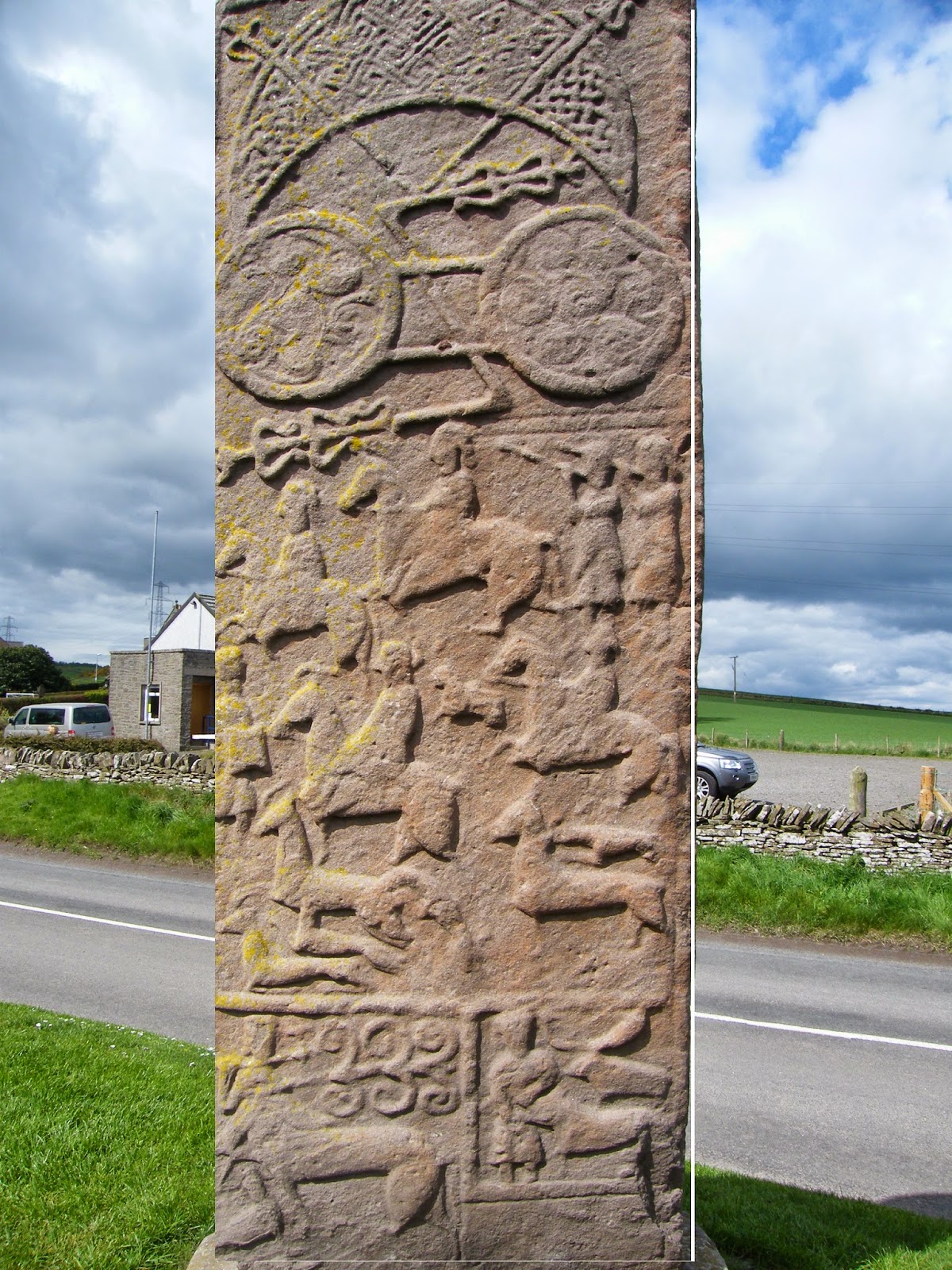
Aberlemno stone showing a ? hunting scene
The power of Northumbria grew unchallenged in Northern Britain.
Oswiu's death in 670 and the succession of his son Ecgfrith created an opportunity for the Picts. They rid themselves of the Northumbrian vassal king and rose in rebellion in 672. Ecgfrith was furious and savagely crushed the revolt with his army of horsemen on the plain between the rivers Carron and Avon. This is the first record of cavalry being used in British history.
It took twelve years for the Picts to recover under their new king, Brudei or Bridei mac Beli, in the lands north of the Tay.
Given the hostility between the two nations and their cultural and ethnic differences, it is a strange quirk of history that the kings, Ecgfrith and Brudei, were cousins. Due to dynastic marriages made by earlier Northumbrian kings, in more peaceful attempts to control the north, they shared a common ancestor in Aethelfrith of Northumbria.
How history repeats itself or, at least, the desire for military conquest among rulers does. Was not the appalling conflict of 1914 called “the cousin's war”?

Remembering the cavalry and the slaughter of 672, the Picts avoided pitched battle in 685 and feigning retreat, lured the Northumbrians into their trap at Dun Nechtan, also known as Nechtan's Mere or  Lin Garan “the pool of the Heron”. The site is usually taken as Dunnichen Moss, a marshy area beneath a fortified hill-top near Aberlemno in Angus. The marsh ws drained in the ninetenth century but appears on old maps.
The Northumbrians were comprehensively defeated and Ecgfrith slain.
 His body was taken to Iona, the resting place of Pictish kings where Brudei himself was laid to rest some eight years later.


 The power of Northumbria was broken north of the Forth and the policy of aggressive amalgamation of the petty kingdoms of Northern Britain under Anglian rule was checked permanently.
 Had there been no victory for the Picts at Dun Nechtan, their country of Alba which morphed into Scotland as subsequent rulers created their own alliances, conquests and marriages, would not have existed. Northumbria might have gone on to unite the southern half of our island,  the Mercians, and the Saxons with its northern empire. Who knows  what would have transpired and would any of it have mattered?
There is another candidiate for Dun Nechtan. Dunachton in the Badenoch has a fortified hilltop, a symbol stone and has many features in its favour but wherever the battle was fought, the outcome was the same - on Saturday 20th May 685, the Picts prevented the kingdom of Northumbria from annexing the whole of Northern Britain.

Is this a depiction of the Battle of Dun Nechtan?

The carved symbol stone in Aberlemno Kirk-yard, appears to show a battle between two armies, with distinctive helmets. Those with nose guards are very similar to those use by the Angles -a depiction of the Battle of Dun Nechtan perhaps.  The sun appears high in the sky between the two upper horsemen and the battle was apparently fought in the afternoon.

The skills of the stone carvers of ancient Pictland survived in their descendants judging by the quality of the lettering in copperplate inscriptions carved into the eighteenth century gravestones in the kirk yard.

Coppper-plate  writing carved on a grave stone
As is the case with most people, who governs you is not as important as how you are governed.   It was the strain of imposed tribute taxes and slavery that caused the Picts to rise up, not the ambitions of their kings.   Nations are merely accidents of history.

Thursday, 8 May 2014

Scots wha' hae


Being in the Trossachs, it was inevitable that when the weather changed from sunny to dreich, we would be drawn to Stirling.   LotH found the Thistle shopping mall was the perfect way to counter the grey skies and I, with time on my hands, headed off to that triumphal(lic) symbol of Scottish nationhood, the Wallace Monument.
 Perched on the  volcanic outcrop of the  Abbey Craig, it dominates the skyline above the site of the Scots victory - the first for many a long year- over the English at Stirling Bridge.


.
Delicately scented bluebells in Abbey Craig woods


  Erected in the 1830's, on a wave of Scottish proto-nationalism fanned by Sir Walter Scott’s romantic tales, it must be one of the biggest monuments to one man..
Climbing the narrow spiral staircase, an anachronism even when it was built in the Scottish Baronial style,  you come into a room with all the information about Wallace and his campaigns and subsequent betrayal by the Scottish nobility. The room is dominated by the enormous Wallace sword, a weapon that would have required great strength to use but does look a bit unwieldy. 
 Up another steep spiral stair, is the  Hall of Heroes.
 Filled with  busts of selected notables from history, the choice of Scottish “heroes”  is somewhat  idiosyncratic with a curious bias towards the Kirk.
Some of the "heroes "are -
George Buchanan, moderator of the Kirk and Thomas Chalmers, leader of the Free Church but no St Columba or St Kentigern
Robert Tannahill, songwriter but no James Hogg
William Murdock, inventor, who changed his name from its Scottish spelling, but no John Macadam
David Livingstone but no Mungo Park
Hugh Miller but no James Hutton.

and, unforgivably, no David Hume.

The Scot who made the greatest impact on the world, who influenced Kant, Schopenhauer, Darwin, Einstein, and thinkers, philosophers and scientists to this day, is not there.   What does this say of the Scottish identity and the influence of the Presbyterian church?

 A final staircase took me out on to the crown with its magnificent views of Stirling, its castle and the Ochil hills.
The loop of the river at the site of  the Battle of Stirling Bridge with the Castle in the distance


I noted there is not a great deal made of the role of Andrew Moray who co-commanded the Scots army at Stirling Bridge.  Moray had successfully led a rebellion against Edward I in his lands in the north-east of the country at a time when Robert Bruce, Earl of Carrick and future king was, with many of the Scottish nobility, swearing allegiance to Edward of England.
 The Morays were a long established, wealthy baronial family with a power base in the north, Morayshire.
Trained from boyhood as a soldier and  military commander, he would have brought some much need skill to the armies of the guerrilla fighter, Wallace. He was wounded at Stirling bridge but still able to sign the letters to the mayors of Lubeck and Hamburg of the Hanseatic League requesting trade continue between them and Scotland and letting them know that they would have safe access to ports.
“ Andrew Moray and William Wallace, leaders of the army of Scotland and the Community….”
The letter was dated 11th October 1297 and it should be noted that Moray’s name preceded that of Wallace.
It is believed that Moray eventually succumbed to his wounds and died  later in 1297.
Had Moray survived, it is open to conjecture whether he would have assumed the subsequent Guardian of Scotland role accorded to Wallace. He would have been, after all, much more acceptable to the nobility of Scotland,than Wallace, being their equal in social class.

“Scots wha hae wi’ Moray bled” ?
It still scans

Moray’s son, Andrew,  did go on to become Guardian of Scotland twice, in 1332 and 1335 and married Christina, sister of  King Robert the Bruce.

Funny… the twists and turns of history and much more complicated than the simplistic tales sometimes peddled.

Tuesday, 6 May 2014

Days in the The Trossachs

A long, long time ago, when I and the world were much younger, I read a Jules Verne story The Child of the Cavern, about  an underground city.  I can’t remember much about it except that it was set in Scotland and was all about a mining community. Somehow I had got it into my head that it was in Fife, a mining area with a history of much digging.
 (Blog April 1st 2014 )


A recent trip to the Trossachs dispelled my misconceptions.  It was Aberfoyle that Verne had in mind with the underground city beneath Loch Katrine.
There never has been any coal mining in Aberfoyle but the man who could conceive of a descent down an extinct volcano to the centre of the Earth, of a giant gun to fire a manned projectile to the Moon or, most famously, of a submarine powered by electricity extracted from seawater, wasn’t going to be put off by a mere geological detail.

Loch Katrine is also the setting for Sir Walter Scott’s Lady of the Lake.   
In the first Canto,the hunted stag seeks refuge...
  
 "By far Lochard or Aberfoyle.
But nearer was the copsewood gray
That waved and wept on Loch Achray,
And mingled with the pine-trees blue
On the bold cliffs of Benvenue".

Ben Venue

In the early nineteenth century  the Trossachs were the just the place for the new Romantic era of Wordsworth and Scott.  Here the literati could revel in the delights of landscape and nature, of mountains and waterfalls, lochs and bens, within easy reach of civilisation in Glasgow, Stirling or Edinburgh and where most people spoke English.
An easy-access Highlands without the dreadful roads, bleak moors, lack of comfort and native Gaelic speakers that would have been the case for most of the country north of the Highland line in Scott’s day.

Scott stayed at Ledard farm and used it  as a setting in Waverley and  Rob Roy, particularly the waterfall above the farm cascading  into what is now called Helen’s Pool.
Ledard farmhouse
 Climbing up the side of Ben Venue to reach the linn, I wondered how Scott, lame from childhood, had managed it, then it dawned on me.  He was a guest at Ledard and, no doubt, would have probably have ridden a garron led by a farm servant up the boggy track.


In Waverley, the beautiful Fiona, seated by the pool below the falls, sings of the clans rising to support the ill-fated Stuart cause.

“Tis the summons for heroes for conquest or death
When the banners are blazing on mountain and heath”


Scott was so impressed with the linn that he used the setting again in Rob Roy  when the narrator, a literary device Scott used to allow him to write in the first person, meets Helen MacGregor, the hero’s wife.


The area abounds in spectacular views.

 Loch Ard like a mirror
"Farewell to the land where the clouds love to rest
Like the shroud of the dead on the mountain’s cold breast
To the cataracts roar where the eagles reply
And the lake her long bosom expands to the sky"


 Another waterfall, the Falls of Arklet at Inversnaid was apparently used as a backdrop in the Kenneth More version of The Thirty Nine Steps


 The Trossachs was the  model for what became the world view of Scotland thanks to Scott and the other Romantics.
It remains a place of great beauty and an inspiration to write …however poor one’s pen.


Monday, 21 April 2014

The Cherry and the Sloe


**
About ane bank, quhair birdis on bewis
 Ten thusand tymis thair notis renewis
Ilke houre into the day: 

The Merle, & Maveis micht be sene,
The Progne, and the Phelomene,*
 Quhilk caussit me to stay:
 I lay and leynit me to ane bus,
To heir the birdis beir,


I saw  my first swallow of 2014 yesterday, skimming over the young barley like a miniature fighter plane.  A marvel of aerodynamics.   Exactly a year since the first sighting of 2013, they have returned.  How do they do it.?
Easter is for some people a time of miracles.  The  immaculate timing of the swallows is my Easter miracle.
The hedgerows are greening up, the gean trees are in blossom, and the spring flowers are blooming. Of course, we are at least two or more weeks behind the south of England where we have just spent a pleasant few days.  There, the bluebells are out in the woods and, at Leeds Castle, among the numbers of water fowl, I noticed the coots and mallards had fledglings.

Leeds Castle


Coots


Here, we are a bit slower in gearing up for summer - only one swallow so far.

The flouris fair wer flurischit,
As nature had them nurischit,
Baith delicate and deir:
And every blome on branche and bewch
So prettily wer spred,


The dean leading to the sea is a dense mass of white blackthorn and yellow whin blossom.  Celandine, named from the Greek for swallow, primrose, dog violet, cowslip, wood anemone and dogs mercury are all out on the braes above the shoreline.


The Dean

The blackthorn blossom undamaged by wind and rain holds out the promise of a good crop later in the year for the sloe gin makers but amount of blossom and subsequent fruiting doesn’t seem to have any rational relationship.  Some years there will be a large number of sloes on one bush and none on another.  One thicket will produce a crop for several seasons then suddenly become barren.  The gean or bird cherry has a fickleness all of its own.  One year the cherries will be as bitter as sloes then the next, tartly sweet.
 At the moment, the froth of blossom is a welcome sight.
The sloe and the gean are as unpredictable as most of life’s occurrences. 
The arrival of the swallows is reassuringly certain.


**  The Cherrie and the Slae  Alexander Montgomerie (circa 1545-1610)
 *  Merle - blackbird    Maveis- thrush
    Progne - swallow     Philomeme - nightingale

There are no nightingales anywhere in Scotland now despite global warming!

Tuesday, 1 April 2014

Underground, overground, wombling free!


A  week on the Fife coast, the “golden fringe on a beggars mantle”, was, despite the sunshine, spent underground for much of the time.
The  news on the telly proclaimed it was seventy  years since seventy six POW's escaped in a tunnel from Stalag Luft III and gave the Beeb an excuse to run “The Great Escape” for the umpteenth time so tunneling was very much the motif of the week.
 This was Fife after all, where the first coal mine under the sea was ingeniously constructed as long ago as 1575, in Culross.
 We also learned that nowhere in Fife, it seems, is pronounced as it is spelt.  Culross is apparently, “Cooross” and we stayed at Kilconquhar which is said like a sneeze - "Kinneuchar", not far from Anstruther or “Ainster"

St Fillan's cave


Pittenweem, the place of the cave, does seem to be phonetically sound, and there we made our first excursion into the bowels of the Earth to visit St Fillans cave, now consecrated as a church.

 
Fife abounds in saints - St Fillan, St Leonard, St Ternan, St Monan, St Rule and , of course, St Andrew.
St Rule's tower

Relics of the patron saint of Scotland were supposedly brought to Fife by St Rule (or Regulus) and the town grew up round the shrine with a castle, cathedral and university as befitted its status and, naturally made it a prime target in the religious strife that is so much part of Scottish history.

The ruins of the castle still stand and, by chance, have preserved one of the best examples of mediaeval siege warfare techniques - tunneling. The technical terms are mine and counter-mine.   Despite the current obsession with “ ‘elfin safety”,  you can still crawl beneath the tower of the castle were the attackers attempted to tunnel in and find the counter-mine made by the defenders who, guided only by the sound of the works and after several unsuccessful starts, broke into the tunnel and defeated them.   Apparently, it took a year to cut through the solid sandstone foundations.  Warfare was a slow business in the sixteenth century. Crouching under the low roof, it was hard to imagine a desperate struggle taking place in these cramped and dark conditions but it did.
The mine started below the tower on the right


The mine
Where mine and counter-mine meet
A plan of the tunnels can be found at 
http://canmore.rcahms.gov.uk/en/site/94410/details/st+andrews+castle+mine+and+countermine/

Warfare in the sixteenth century concerned small groups of armed men confronting each other whether in open field or holes in the ground.


Twentieth century wars were to have been fought and wrought by whole populations with few expected to survive.   Even the privileged few were likely to spend their last days or weeks trapped deep underground.


A visit to the nuclear-bomb-proof bunker - Scotland’s Secret Bunker- was especially interesting for us as such a bunker was built just next to our village.  Our bunker was never used.  Some say an underground spring flooded the lower levels and, certainly, when I made my one and only visit into its depths there was water beneath the concrete flagstones.   My visit was by torchlight.  The darkness was total, so dark you felt you could touch the blackness, and completely silent, no wind or rain, no bird song, no distant cars or noise of human activity, nothing penetrated the fifteen feet thick concrete walls. 
It was one of the most frightening places I have ever been in.
The bunker in Fife was fully operational up until the seventies and easily accessible, so it was with a degree of interest that I anticipated seeing what had been hidden from the pencil beam from my puny torch in our local version.
 No wonder I couldn’t see much by torchlight in the sealed-off version I visited . The bunkers are massive , the size of two football pitches, one on top of the other, one hundred feet underground.


The dummy house covering the entrance of standard MoD design

On arrival, I noted the dummy house that covers the entrance, is an exact copy of the one at our village.  Obviously the M.o.D. had only one design.

www.secretbunker.co.uk

Down fifty yards of sloping tunnel - everything was in imperial measure when this monster was built- was a whole world designed to withstand a nuclear blast and allow the protected few to govern the country afterwards.
An unidentified RAF operative manning the switchboard

A futile plan that thankfully was never put to the test.   A Cold War relic that is now a tourist attraction.
Back up in the sunlight, it was time to reflect but not too much, then off to Anstruther… sorry, Ainster, for  a visit to the famous fish and chip shop.

Thursday, 20 March 2014

It's a chill wind


Greater celandine gets torn by the wind but is the arch survivor

It is the vernal equinox and true to the old adage the winds have increased.  The statistics seem to show that there is no validity in the belief that there are storms around the equinoxes but  the cold wind has suddenly returned after the sunny days of early March.  It seems odd that such a widespread belief should have no scientific basis.  Dickens mentions them and even Sherlock Holmes is surprised to receive a visitor such is the severity of the equinoctial gale in  The Adventure of the Five Orange Pips.
The equinoctial gales are more often noted at the autumnal equinox in late September and early October but are also associated with the equal days of spring.


A teuchat

My grandfather, a farmer, called the autumnal gales the “teuchat storms” as they occurred as the teuchats (peewits or lapwings), started to move on to the farmlands from higher summer pastures and their numbers were augmented by over-wintering flocks from Northern Europe.


Lambs can stand the cold winds but rain  is a hazard

The spring gales were often called the “lambing storms” by  reason of their timing.  Yet we are informed that it is all a misapprehension and that there is no evidence of wind and weather changes specifically at the equinoxes.    Be that as it may, it has been a cold windy week


Tuesday, 18 March 2014

The Brownie of Bodsbeck


 James Hogg monument at The Loch of the Lowes

James Hogg is now being given the status he deserves as a writer.  During his lifetime and for long afterwards, he was regarded as a minor figure in Scottish  literature.  Befriended but patronised by Scott and the  Edinburgh literary establishment, his true ability wasn’t fully recognised.
 Now, his Confessions of a Justified Sinner is seen as a truly modern novel
The Brownie of Bodsbeck is his tale of the bloody strife that surrounded the struggle between the Stuart kings on their new English throne and their Presbyterian Scottish subjects
Published after Sir Walter Scott’s Old Mortality, it received little of the latter's popularity but Hogg himself was always at pains to point out that it was written before Scott’s novel but held back by the publisher, presumably not to foreshadow and possibly devalue what was certain to be another bestseller from Scott.
Scott has been accused of caricaturing the Covenanters and white-washing the Royalists which is what one would expect from a member of the Tory establishment.  True or not, Hogg’s account is much  more from the people’s point of view as they saw their herds seized, their relatives shot and tortured by ruthless agents of the Crown.   James Graham of Claverhouse, latterly Viscount Dundee, was such a man and his swathe of suppression through the Borderlands forms the background to the novel.
The Watch Law from where a lookout was kept during Covenanter services

 A group of Covenanters, mainly in the southwest, followed the teachings of Richard Cameron and offered armed resistance to the Crown
When the crown ejected ministers from their parishes for refusing to submit to the rule of bishops, the Covenanters followed them to the hills and worshiped at open air services called conventicles.
Every year in July, an open air “Blanket preaching” is held at the Kirkyard of St Mary of the Lowes by St Mary’s Loch in Yarrow in memory of the Covenanters.
http://www.selkirk.bordernet.co.uk/news/30.html

 As the threat from government forces increased the Covenanters began to carry weapons to their conventicles and to post armed pickets to keep a lookout.
The Cameronian regiment - The Scottish Rifles - which arose from these Covenanting origins, continued to take their rifles to church parades and to post sentries at each service until disbanded in 1968

Chapelhope

Hogg’s story concerns Katherine the daughter of the farmer at Chapelhope, a farm in Yarrow.   Hope is one of these intriguing geographic terms. On the coast it means a bay- Longhope.  In the hills it means a valley or hollow .  There are several hopes in the Brownie of Bodsbeck - Kirkhope, Riskinhope,  Kershope
  Katherine plays on the superstitions of her family and neighbours by pretending to be in league with the Brownie of Bodsbeck allowing her access to the moors at night.   According to custom, brownies must be placated with food - bannocks and milk, thus Katherine is able to hide and feed the fugitive Presbyterians in the hills.
Clerk, the cowardly priest, a Royalist spy who denounces his parishioners, attempts to seduce her under the guise of exorcism but is unhinged when he meets, Katherine’s brownie - a  escaped Cameronian, twisted and misshapen by torture and hidden by her in a cave under the waterfall at Chapelhope.
 It is clear where Hogg’s sympathies lay and, with only eighty years separating his birth from the death of “Bluidy Clavers” at Killiecrankie,  his childhood would have been filled with tales of the “Killing Times”.

The Brownie of Bodsbeck is, at times, difficult as some of the dialogue is in the everyday speech of the locals which even in Hogg’s day contained many words that were slipping out of usage.  He makes passing reference to this when Clavers is interrogating an old shepherd and  admits to not understanding him

Chapelhope still has its beautiful linn or waterfall but never was there a cave.


The chapel that gives the hope its name and where the sly priest Clerk spied on his flock is now a series of grassy mounds and the only flock that attends there are the sheep.

Rodono Chapel ruins


All is now quiet and peaceful with few reminders of the death and oppression visited on the people of the valley, but perhaps the hills remember.