Sunday, 29 September 2013

In the autumn of my days

The swallows have gone but the warm sunny days belie the presence of Autumn.  An Indian summer...why an Indian summer?    Apparently, it  came into use when the first colonists on North America noted these warm periods in autumn were essential to the native Americans for gathering their harvest and stores in preparation for their harsh winters.
 It is probably no longer politically correct to use the expression and we can't call the phenomenon a "Native or Pre-Columbian American Summer".  Perhaps we should go back to  St Martin's summer or St Luke's summer, so-called because of the feast days of these saints.   In some countries they call it an "old ladies" summer.
Whatever the name, it has been so enjoyable to get out and roam the countryside.  The grain harvest is past and the potatoes are being lifted. The days of the tattie howkers are long gone though a few still refer to the October school holiday as  " the tattie holidays", remembering a time when the back breaking toil of  picking up the crop by hand was a source of revenue for school-children. Now a machine does it all, its great curved tail depositing the earthy haul into the waiting trailer like a giant insect laying eggs.


The hedgerows are laden with fruit though how much will survive the slashing of the mechanised cutters is a concern for those of us interested in the survival of our bird life.
Why cut the hedges now?


A walk out to the Duddo stones raised the spirits. Set on an insignificant hillock, because of the surrounding topography, they command superb views of the surrounding country and distant hills.   They have stood for more than four thousand autumns, a tribute to the belief system that compelled the Neolithic farmers to erect them.  They give a perspective to our short lived concerns.

Duddo stone circle sometimes called the Singing Stones

The weathered face of the largest stone

A little further on the road was a small nature reserve.   A lowland moss formed at the end of the Ice Age, it had been the site of coal mining for three centuries.  Now Nature is reclaiming it.    The remains of the mine works look incongruous in the landscape and the workings themselves are all but gone.

The old mine workings on the Ford Moss

Nature seems to surmount all we can do to it … up until now, at least.
   
John Clare got it right.  Children plucked daisies long before the Duddo Stones were stood on end and children will probably pluck daisies thousands of years from now but the daisy will still be the same.   
“..A music that lives on and ever lives” *
Yet the landscape that the Neolithic farmers knew and  or that of John Clare, would have been vastly different from what we see today. For more than five thousand years we have been managing and shaping it.  Even the five Duddo Stones were once seven, two being removed to let the  plough come closer.
 Thousands of years of belief  exchanged for a few ears of grain. 
They are still  one of the most dramatic and impressive sites, especially on a beautiful, autumnal day with the blue shapes of the Cheviots, the Eildons and the edge of the Lammermuirs on the encircling horizon.


*  The Eternity of Nature    John Clare

Wednesday, 18 September 2013

Summer's lease has still to run


Autumn is officially here, the “season of mists and mellow fruitfulness“.  Keats has got it right this year. The apple and  plum trees are hanging with fruit and the brambles, a taste of childhood, are fat and juicy.

The autumn crocuses and cyclamen are in flower under the cherry tree.
Yet, the swallows remain, flying their sorties over the stubble fields, rough shaven by the combines.   As long as they stay there is just a trace of summer to enjoy.  Suddenly they will be gone, one day swooping up to twitter in ranks on the telephone wires, the next, gone …every one…each obeying their own inner calendar yet leaving en masse and bringing the dark days of winter that bit closer.
Still the sun still shines and the winds, though northerly, are not too chill.


The pastures up on the moor are pink with sheep sorrel and the fungi are making their showy appearance in the woods. Winter is a long way off.


A bumble bee.. I think,a buff-tailed bumble bee …was hovering over a patch of grass and whins... then crawling about in the grass as if searching.   I wondered if it was a queen looking for a mouse hole or similar to make a nest for the winter.   It didn’t find any place that suited  it and flew off.  Even with  bumble bees, location, location, location… is everything.

The butterflies have been feasting on the rotting windfall apples...mostly peacocks which we seem to be seeing more and more often.   Presumably they too are stocking up on supplies before hibernation.   LotH bred a lot of Painted Lady butterflies in a lepidopterum, if that’s the word, last year and has been disappointed not to see any in the garden this year but I don’t think butterflies are like swallows or salmon… returning to their birthplace to breed.  They are a  truly beautiful excuse for not weeding.  Any remarks about the nettles in the borders are fended off with the retort that they are there for the butterflies!


 This handsome gentleman is still wearing his russet summer coat, though he seems haughtily suspicious of strangers


 "And stared at me. And so for some lasting seconds
I could think the deer were waiting for me
To remember the password and sign"       *


*Ted Hughes   The Roe Deer

Wednesday, 28 August 2013

Footsteps of Flodden revisited

  The exhibition on the life of Mary, Queen of Scots at the Scottish National Museum is superb.  The timelines of her convoluted personal and political life are easy to follow and  make it clear that so many of the problems that beset her reign were the unforeseen and, in some cases, unforeseeable, results of  her or someone else’s actions.

http://www.nms.ac.uk/our_museums/national_museum/upcoming_exhibitions/mary_queen_of_scots.aspx


Mary seems to have inherited her impetuosity from her grandfather, James IV, the  calamitous loser at the Battle of Flodden, an event that scarred Scotland for years.    Not so much from the slaughter of the nobility,  most of whom were only motivated by self interest and acquisition, but for the loss from the clerical and commercial classes. This set back for decades, the economic and intellectual life of the country, that had been flowering under the Renaissance ideals of James.
By the time Mary came to the Scots court,  it appeared unsophisticated  and dominated by the uncouth ruffians that passed for  the aristocracy, though the Reformation had brought the beginnings of  that far seeing experiment - a school in every parish- that was to lead to widespread literacy and, eventually, to the Scottish Enlightenment but what a struggle it was to get there.
 It is five hundred years since  James ‘s disastrous foray across the border to Flodden Field and, last weekend, a walk was arranged along  thirteen miles of the route taken from Edinburgh across the Lammermuirs to the mustering point at Ellemford on the Whitadder.  

http://www.lammermuirlife.co.uk/In-the-Footsteps-of-Flodden.cfm

 Play-lets and  encounters were set up to entertain the walkers and to give a voice to the “others”.. the camp followers, the commoners,  those pressed into service, those on the make…the ones that don’t appear in  the historic accounts.


In the Footsteps of Flodden - A knight and his servant have thoughts on their situation!


In the Footsteps of Flodden- a "penny-jo" accosts two young recruits on the march!

The day finished with “ Ghosts” a tribute to all the young men killed in battle since 1513,  in all the wars and campaigns. Men who were conscripted, duped or pressed into service of arms with no choice but to obey.   The finale was that ultimate in laments, The  Floor’s o’ the Forest, made all the more evocative by the soft summer rain that set in as the walk finished.


To paraphrase, or misquote, both Toynbee and Hubbard… history, like life, is just one damn thing after another.  In  most of Scottish history.. and probably the rest of humanity as well…it seems  to lurch from one calamity to the next with not much in the way of  reasoning or logic.  The religious or political philosophy that  there is a plan, divine or otherwise, behind it all, seems wide of the mark.    History like evolution , doesn’t seem to have any fixed aim or ending.  It just proceeds with sudden leaps or turns when a variation  of the norm occurs.
Even our planned walk had its twists, false starts and repeat performances but, by and large, it could be counted a success which is more than can be said for Mary Queen of Scots or James IV…their achievements were overshadowed by their mistakes.
 Poor old James, invaded another country, thought it would all be over in a few days, didn't have a real objective, didn't have an exit strategy,.......history doesn't always repeat itself but it does rhyme as somebody once said.  Somebody also said it is the sum total of things that could have been avoided.
 If only only we could learn from history but we never do so we seem doomed to repeat it ...and usually at the expense of young lives.

Monday, 19 August 2013

Requiem for a hedgehog


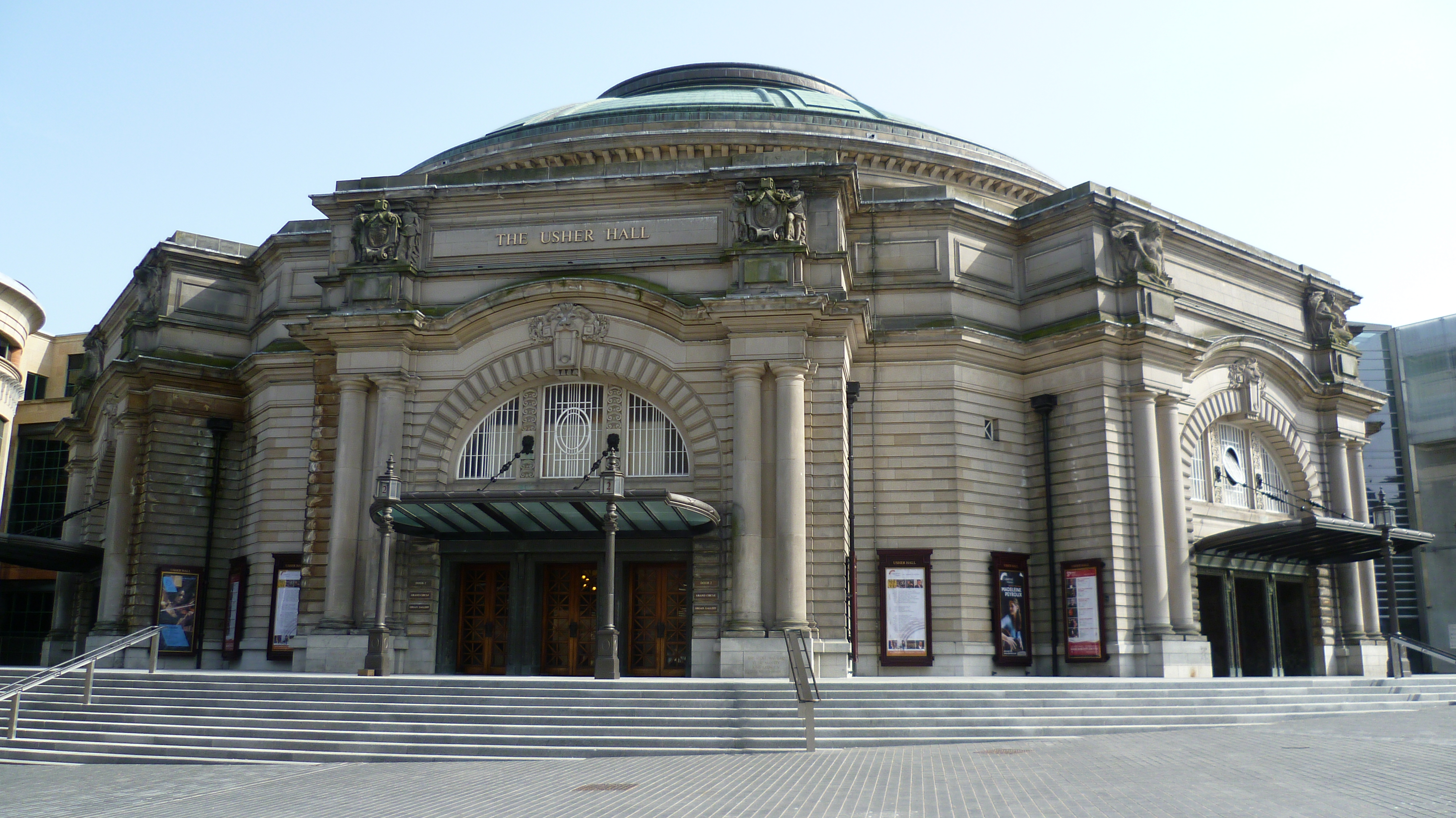
File:Usher Hall, Edinburgh.jpg
Usher Hall

August in Edinburgh means The Edinburgh International Festival.   There is also the Fringe where the old lady hoists her skirts and kicks her legs with the odd flash of garter but, for the Festival proper, she assumes her best going-out-to-the-theatre hat and makes her way to the douce sobriety of the Usher Hall.      So it was that a scruffy latecomer such as me, managed to squeeze himself into possibly the last available seat.

Perched in the vertiginous heights of the upper row of the upper circle, I exchanged pleasantries with my fellow alpinists.  We were a motley lot… American, Japanese…no doubt, there to hear their own Mitsuko Uchida’s expressive playing of Beethoven’s Fourth Piano Concerto… a city-suited gent, a collection of casually dressed tourists and formally dressed locals who had left it late to get tickets and had to settle for a seat in “the gods”.

Tchaikovsky’s Sixth is often described as a warhorse having been performed so many times in so many places but, no matter how often it played, it still has the power to speak to each person in the audience, an emotive appeal that’s individual to every listener.

Some of the audience were so carried away by the stirring march of the third movement that they burst into spontaneous applause…maybe they thought that nothing could follow it…but had to endure the anguish of the final movement and its conclusion of reflective, acceptance of the desolation of fate, of the end of a life

Getting back to the country, I stepped out into the garden to watch the beginning of the Perseid meteor showers.  It seemed appropriate given the theme from Tchaikovsky’s first movement was reworked into the pop song “The Story of a Starry Night”.

http://www.youtube.com/watch?v=FUVBTP9JKXA
  Head back, staring up at Perseus, his love, Andromeda, and his perfidious in-laws, the W-shaped Cassiopeia and Q-shaped Cepheus, I didn’t notice the hedgehog snuffling over the lawn, nor him, me.    As soon as I moved, he shot off into the shrubs.

 We haven’t had hedgehogs around here for years so the encounter lifted my spirits and, for the next couple of nights, I left some meal worms out for my guest hoping to encourage him to stay in the safety of the garden.

A week later, my new chum was dead on the road, like so many of his kind.      His race have been around from long, long before Perseus killed Medusa to win Andromeda, his prickles making him invulnerable. Yet now, we seem determined to exterminate his kind and are succeeding.

There is a slow, resigned sadness in this.  It seems inevitable.   Maybe they deserve the Pathetique more than we do.

Thursday, 1 August 2013

"Was there ever a master of motor cars as Toad of Toad Hall?"


Mr Toad made a rare appearance.   We don’t see him around the garden but every so often he turns up.  The last sighting was in 2009.  Then, we thought it was prompted by the arrival of a new motor car, toads being known to have a predilection for motor cars.  Poop,poop !
 No such novelties were at hand on this occasion so he was probably just enjoying the humid weather with it abundance of the sort of delicacies that toads like to eat.

Toad and his adventures with motor cars on the open road mirrored the experiences of early drivers and resulted in the creation of the RAC and the AA, organisations that existed to help stranded motorists.  I can remember the patrolmen on their motor-bikes saluting the cars that carried their badge.  It used to be believed that, if they didn’t salute, there was a speed trap ahead.
 After getting my first car, I duly obtained my badge and the key to the roadside boxes from whence help could be summoned.    Much to my later disappointment, I left my badge on my first car when I sold it and never liked the modern version but, strangely enough, I still have the key.


It was with delight that I came across one of the few remaining AA boxes at Cappercleuch near St Mary’s loch.    A reminder of pre- MOT motoring when cars, especially the kind I could afford, were completely unreliable, when fan-belts were regularly replaced by a nylon stocking, radiators boiled over and hoses perished.
I’m sure Mr Toad hankers after those days but not me, I like surround-sound, climate control, warning lights and beeps of every possible kind.  I’ve no wish to go back to standing in the rain trying to figure out why a pile of unresponsive metal won’t move.
Still, it was nice to see an AA box again.


An unexpected sight


Apparently ,out of eight hundred boxes, there are nineteen left and eight of them are Grade II listed buildings
A " listed" building


Mr Toad  would have approved of them.  He needed  all the help he could get on the road.

Tuesday, 30 July 2013

Stories from the Grave


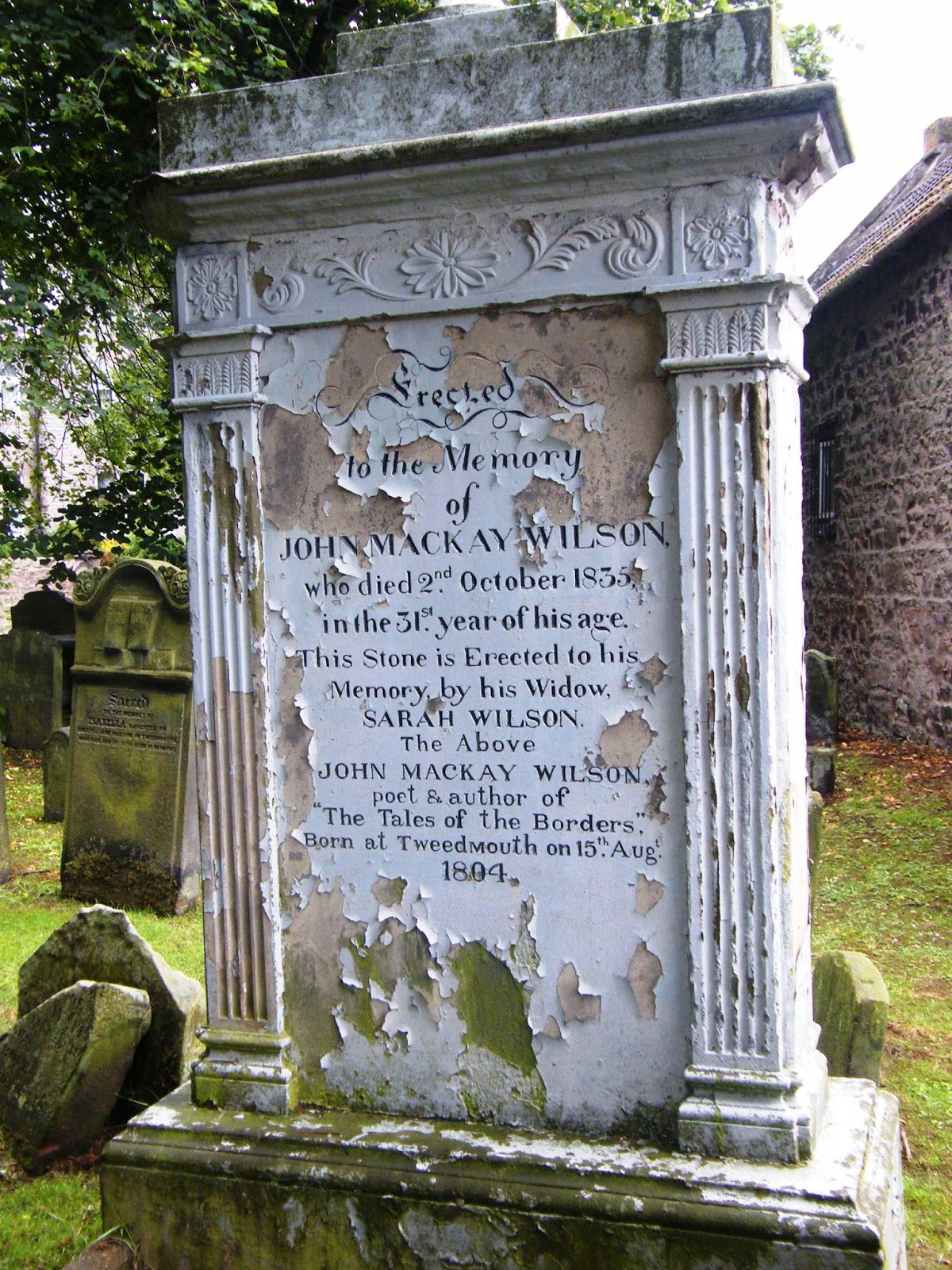
Wilson’s Tales of the Borders was a series of short stories, mostly traditional, published in serial form in Victorian times. The weekly magazine proved hugely popular and later contributors included Hugh Miller and David Moir who wrote as “Delta” in Blackwood’s  Magazine.
John Mackay Wilson was born in Tweedmouth, Berwick upon Tweed and is buried there.


Wilson's neglected grave in Tweedmouth churchyard

Years ago, I came across an old copy of the Tales and thought some might be fashioned into a series of plays, tied together by their location, following the Tweed  from its source to the sea.     Nothing came of the project at the time.
I was invited to become involved in a re-appraisal of his work.  There may be an attempt to dramatise  “The Tales”.

http://www.wilsonstales.co.uk/  

 With this new interest, I dusted off the old scripts and went to look again at the places that inspired the stories.
A trip up the romantic Yarrow valley to where the Megget Water flows into St Mary’s Loch, found me revisiting the grave of Perce Cockburn, Laird of Henderland and border reiver, executed by James V in 1530. His wife, Marjory, was buried beside him in the ruined chapel on Chapel Knowe

Cockburn's grave

 The Border ballad “The Lament of the Border Widow” is supposed to recall the events.

Tradition has it that he was hanged from a tree at the door of his own castle and, as such, it is recounted in “The Royal Raid” in Wilson’s Tales.  In reality, Cockburn was beheaded in Edinburgh.  The grave slab is a strange mixture of 13th and 16th century carving, the lettering being that of the 1500s but the sword and cross of a style common two hundred years earlier.  


The slab is covered in moss and lichen but the sword is discernible on the left


Maybe the ballad has melded two events in the same way as the old stone has been re-used to commemorate Cockburn and his wife.
 Anyway, Wilson’s version has more impact and pathos than the legalistic truth.
It makes for more drama as Cockburn is dragged out and hanged at his own front door.


My love he built me a bonny bower,
And clad it a' wi' a lilye flower,
A brawer bower ye ne'er did see,
Than my true love he built for me.

There came a man, by middle day,
He spied his sport and went away,
And brought the king that very night,
Who brake my bower, and slew my knight.

He slew my knight, to me so dear;
He slew my knight, and poined his gear;
My servants all for life did flee,
And left me in extremitie.

I sewed his sheet, making my mane;
I watched the corpse, myself alane;
I watched his body, night and day;
No living creature came that way.

I took his body on my back,
And whiles I gaed, and whiles I sat,
I digged a grave, and laid him in,
And happed him with the sod so green.

But think na ye my heart was sair,
When I laid the moul' on his yellow hair;
Think na ye my heart was wae,
When I turned about, away to gae?

Nae living man I'll love again,
Since that my lovely knight is slain;
Wi' ae lock of his yellow hair
I'll chain my heart for evermair.


Sparse, moving, honed by oral transmission, the verses contain not an extraneous word yet they deliver the brutal truth and harrowing emotion, precisely and perfectly.
It will be near impossible to follow it.

Sunday, 28 July 2013

The Wildwood revisited


In 1990, a yew bow was found by a hill walker above Carrifan Gans in the Tweedsmuir hills.
 The bow turned out to be early Neolithic about 6000 years old.  It is now in the Museum of Scotland

http://www.nms.ac.uk/our_museums/national_museum/explore_the_galleries/scotland/early_people/a_generous_land.aspx

 This started a project to recreate a microcosm of the landscape occupied by the hunter who lost or threw away, his bow all those Millennia ago – The Wildwood. 

http://www.carrifran.org.uk/

I became a founder as a dedication to a four legged companion who accompanied me on so many expeditions to the hills.
I last visited the valley in 2007 and thought  that now was the time for another look.  Thousands of native trees have been planted, faithful to the pollen samples found in peat cores, evidence of those growing on the site in the wild-wood times.
The valley 2007
Even after a few years the view has changed as the trees colonise the slopes and the wild flowers return to the undisturbed valley bottom.

The valley 2013
Rosebay Willow Herb
The path was alive with butterflies and moths though still fewer bees than one would have liked to see.   Rosebay willow-herb, the fire weed, is so common it’s usually overlooked but great stands of it in full bloom made a tremendous foreground to the brooding slopes of the hills. Tormentil carpeted the path and asphodel, lousewort and meadowsweet grew in clumps along stream’s edge.
Above me the buzzards circled, their “pee-you” cries sounding elemental and ancient.
Bog Asphodel
Six years is not long in the span of time in a wood-land, but already the faster growing birch, hazel and rowan are looking mature.  
Filberts
The hazel bushes had filberts as one would expect as August  20th  is St Philbert's day

They will be followed over the years by  larch, alder, ash and oak.
I won’t live to see the return of the mature woodland but my grandchildren may and, certainly, my great- grandchildren will.  (d.v.)
The passage of the years was emphasised as I reached the head of the valley, gouged by glaciers long before even the Stone Age hunter came.  The steep rise to the source of the Carrifran Burn, is aptly name Raven Craig and, between that and its neighbour, Priest's Craig, lies Priest's Gill where a tributary of the burn cascades over a waterfall. 
Ravens craig & Priest's Craig


The valley from Ravens Craig 2007


Priest's Gill


   In winter, six years ago I climbed it to photograph the frozen waterfall.   Today, in the summer heat, I thought better of it, consoling myself that I wasn’t properly equipped but really wondering if I could still manage it.   Yes, I’m sure I can.   I’ll organise another trip…..soon.
Frozen waterfall 2007


 As I drove away from Carrifran, the contrast of the biodiversity and richness of the wildwood project, even at this early stage, with the surrounding hills was profound.

Hundreds, indeed thousands, of years of agriculture have changed our land so greatly that what  we have come to think of as natural, the rolling hills and moors, are ecological deserts with their sheep-bitten turf and  monoculture forests.     Hopefully, there might be a balance where the subsidies and tax advantages bestowed on sheep farmers and foresters could be applied to longer term  projects that would re-establish at least some of  great temperate forest that once covered our country. 
  Much is made, and rightly so, of preserving the rainforests with their diversity of flora and fauna, but it is sometimes forgotten that much our own forests were destroyed hundreds of years ago to be replaced by now largely redundant sheep whose existence is supported by the taxpayer. So embedded is the the sheep in our politics that the Lord Chancellor sits on the Woolsack!
 Sheep were a mainstay of the economy from the early middle ages onwards but maybe now we should be thinking again.