Tuesday, 30 July 2013

Stories from the Grave


Wilson’s Tales of the Borders was a series of short stories, mostly traditional, published in serial form in Victorian times. The weekly magazine proved hugely popular and later contributors included Hugh Miller and David Moir who wrote as “Delta” in Blackwood’s  Magazine.
John Mackay Wilson was born in Tweedmouth, Berwick upon Tweed and is buried there.
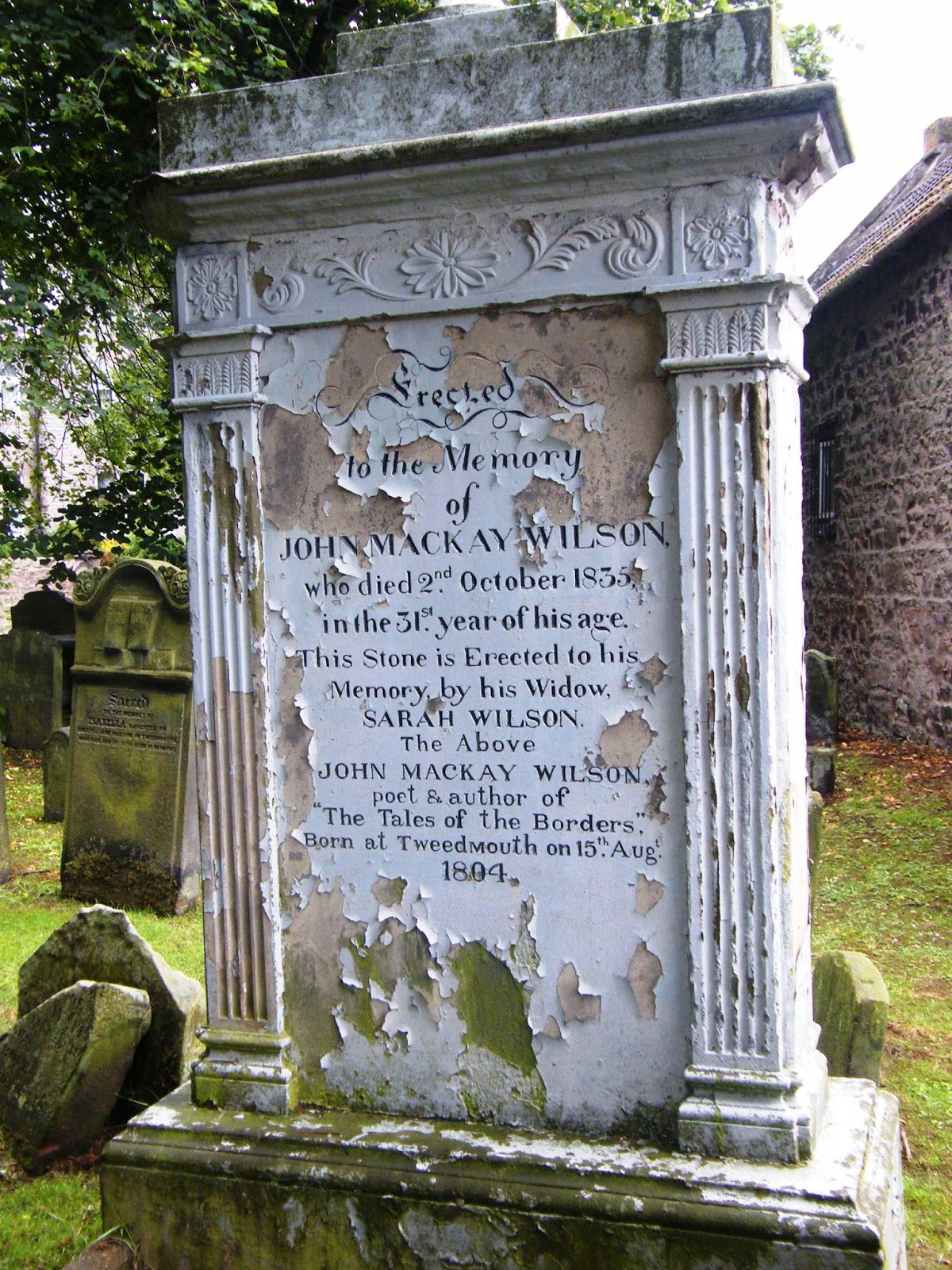

Wilson's neglected grave in Tweedmouth churchyard

Years ago, I came across an old copy of the Tales and thought some might be fashioned into a series of plays, tied together by their location, following the Tweed  from its source to the sea.     Nothing came of the project at the time.
I was invited to become involved in a re-appraisal of his work.  There may be an attempt to dramatise  “The Tales”.

http://www.wilsonstales.co.uk/  

 With this new interest, I dusted off the old scripts and went to look again at the places that inspired the stories.
A trip up the romantic Yarrow valley to where the Megget Water flows into St Mary’s Loch, found me revisiting the grave of Perce Cockburn, Laird of Henderland and border reiver, executed by James V in 1530. His wife, Marjory, was buried beside him in the ruined chapel on Chapel Knowe

Cockburn's grave

 The Border ballad “The Lament of the Border Widow” is supposed to recall the events.

Tradition has it that he was hanged from a tree at the door of his own castle and, as such, it is recounted in “The Royal Raid” in Wilson’s Tales.  In reality, Cockburn was beheaded in Edinburgh.  The grave slab is a strange mixture of 13th and 16th century carving, the lettering being that of the 1500s but the sword and cross of a style common two hundred years earlier.  


The slab is covered in moss and lichen but the sword is discernible on the left


Maybe the ballad has melded two events in the same way as the old stone has been re-used to commemorate Cockburn and his wife.
 Anyway, Wilson’s version has more impact and pathos than the legalistic truth.
It makes for more drama as Cockburn is dragged out and hanged at his own front door.


My love he built me a bonny bower,
And clad it a' wi' a lilye flower,
A brawer bower ye ne'er did see,
Than my true love he built for me.

There came a man, by middle day,
He spied his sport and went away,
And brought the king that very night,
Who brake my bower, and slew my knight.

He slew my knight, to me so dear;
He slew my knight, and poined his gear;
My servants all for life did flee,
And left me in extremitie.

I sewed his sheet, making my mane;
I watched the corpse, myself alane;
I watched his body, night and day;
No living creature came that way.

I took his body on my back,
And whiles I gaed, and whiles I sat,
I digged a grave, and laid him in,
And happed him with the sod so green.

But think na ye my heart was sair,
When I laid the moul' on his yellow hair;
Think na ye my heart was wae,
When I turned about, away to gae?

Nae living man I'll love again,
Since that my lovely knight is slain;
Wi' ae lock of his yellow hair
I'll chain my heart for evermair.


Sparse, moving, honed by oral transmission, the verses contain not an extraneous word yet they deliver the brutal truth and harrowing emotion, precisely and perfectly.
It will be near impossible to follow it.

Sunday, 28 July 2013

The Wildwood revisited


In 1990, a yew bow was found by a hill walker above Carrifan Gans in the Tweedsmuir hills.
 The bow turned out to be early Neolithic about 6000 years old.  It is now in the Museum of Scotland

http://www.nms.ac.uk/our_museums/national_museum/explore_the_galleries/scotland/early_people/a_generous_land.aspx

 This started a project to recreate a microcosm of the landscape occupied by the hunter who lost or threw away, his bow all those Millennia ago – The Wildwood. 

http://www.carrifran.org.uk/

I became a founder as a dedication to a four legged companion who accompanied me on so many expeditions to the hills.
I last visited the valley in 2007 and thought  that now was the time for another look.  Thousands of native trees have been planted, faithful to the pollen samples found in peat cores, evidence of those growing on the site in the wild-wood times.
The valley 2007
Even after a few years the view has changed as the trees colonise the slopes and the wild flowers return to the undisturbed valley bottom.

The valley 2013
Rosebay Willow Herb
The path was alive with butterflies and moths though still fewer bees than one would have liked to see.   Rosebay willow-herb, the fire weed, is so common it’s usually overlooked but great stands of it in full bloom made a tremendous foreground to the brooding slopes of the hills. Tormentil carpeted the path and asphodel, lousewort and meadowsweet grew in clumps along stream’s edge.
Above me the buzzards circled, their “pee-you” cries sounding elemental and ancient.
Bog Asphodel
Six years is not long in the span of time in a wood-land, but already the faster growing birch, hazel and rowan are looking mature.  
Filberts
The hazel bushes had filberts as one would expect as August  20th  is St Philbert's day

They will be followed over the years by  larch, alder, ash and oak.
I won’t live to see the return of the mature woodland but my grandchildren may and, certainly, my great- grandchildren will.  (d.v.)
The passage of the years was emphasised as I reached the head of the valley, gouged by glaciers long before even the Stone Age hunter came.  The steep rise to the source of the Carrifran Burn, is aptly name Raven Craig and, between that and its neighbour, Priest's Craig, lies Priest's Gill where a tributary of the burn cascades over a waterfall. 
Ravens craig & Priest's Craig


The valley from Ravens Craig 2007


Priest's Gill


   In winter, six years ago I climbed it to photograph the frozen waterfall.   Today, in the summer heat, I thought better of it, consoling myself that I wasn’t properly equipped but really wondering if I could still manage it.   Yes, I’m sure I can.   I’ll organise another trip…..soon.
Frozen waterfall 2007


 As I drove away from Carrifran, the contrast of the biodiversity and richness of the wildwood project, even at this early stage, with the surrounding hills was profound.

Hundreds, indeed thousands, of years of agriculture have changed our land so greatly that what  we have come to think of as natural, the rolling hills and moors, are ecological deserts with their sheep-bitten turf and  monoculture forests.     Hopefully, there might be a balance where the subsidies and tax advantages bestowed on sheep farmers and foresters could be applied to longer term  projects that would re-establish at least some of  great temperate forest that once covered our country. 
  Much is made, and rightly so, of preserving the rainforests with their diversity of flora and fauna, but it is sometimes forgotten that much our own forests were destroyed hundreds of years ago to be replaced by now largely redundant sheep whose existence is supported by the taxpayer. So embedded is the the sheep in our politics that the Lord Chancellor sits on the Woolsack!
 Sheep were a mainstay of the economy from the early middle ages onwards but maybe now we should be thinking again.


Friday, 26 July 2013

Music hath charms...


Paxton House

Paxton House, an Adam mansion stuffed with Chippendale furniture, what better venue for an evening of musical entertainment, especially if it is provided by two trios of pretty young ladies?
The house was commissioned by Patrick Home for his intended bride, Sophie de Brandt, lady-in-waiting to Queen Elizabeth Christina of Prussia.  Their love was never realised and Patrick sold the house to his cousin Ninian who finished the building.
The picture gallery is the largest in a private house and now houses a collection of 18th century paintings from the National Gallery of Scotland…portraits of the great and the good….well, the rich, at least.
The space of the gallery didn’t save us from the thundery closeness of the summer night.

Arunda with oboe, clarinet and bassoon, gave a sparkling performance of pieces by Mozart…  you have to have  Mozart somewhere in a chamber music evening…as well as a lullaby-like  romance by George Auric, well known for his film music.
Their rendering of Jean Francaix’s quirky Divertissement was almost cinematic.  Although written in 1947,  it sounded, to my untutored ear, like the soundtrack to the jerky, grainy films of the early twentieth century… almost Chaplinesque at times… but what do I know?   It was great to listen to.
 La Petite Patisserie by Leclair, with its parade of cakes and croissants cried out for  Disney to animate it.

The second half of the concert was given by the Trio Isara, piano violin and cello.
Their playing was superb.  Beethoven’s piano trio in E flat major and Mendelssohn’s   popular D minor trio were played with the passion demanded.
As the three finished with a flourish, I glanced up at the portrait of a heavy jowled, sombrely clad, upright citizen looking down on them.    I almost imagined the dour Scots face giving a wee smile of approval.   It must have been the heat making me fey.


 This yew was probably a around when Beethoven was writing his piano trio

Monday, 15 July 2013

X-craft


Islands in the  Forth - Fidra & Lamb

A sunny day, a stroll out to Aberlady bay with the breeze coming off the sea carrying the almond scent of meadowsweet, - what could be more pleasant?

Fritillary on red clover
The sandy paths cut through a profusion of wild flowers of every hue from the deep purple of woody nightshade, the purple orchids, through red clover to the  pink of ragged robin  and lousewort then the brilliant blue of vipers bugloss and vibrant yellow of ragwort and spearwort  and everywhere, butterflies, damsel flies and burnet moths.  Reed buntings sang from hawthorn bushes, swifts, swallows and martins swooped and swerved over the sedge grasses and bog cotton…a day to be thankful for.

Ragged Robin

Woody nightshade


Burnet moth on bush vetch


The concrete anti-tank blocks have been colonised by lichen making them look like Australian aboriginal art, something from Dreamtime… odd how nature can soften something so ugly and inimical into a thing of unexpected charm.


 Further out, on the long sandy beach, are the wrecks of two XT-craft, four man midget submarines used in WWII.   


   Four men spent days crouched in these tiny vessels only able to surface for short periods at night..  For a claustrophobe who needs to be out in the fresh air with space to move freely, my admiration for them knows no bounds!


There are scores of beautiful shells half embedded in the sand. I think they are called otter shells, bringing to mind pleasing images of a sea otter lying on its back with a stone in its paws, cracking open a shell balance on its abdomen.


The two X-craft were exposed to a different type of shell, having been used for target practice when their role was no longer required.
In the event of an invasion in 1940, this beach might have been the German equivalent of the Normandy D-Day beaches. The possibility of landings from Nazi-occupied Norway in support of a cross-Channel invasion was taken very seriously, hence the anti-tank obstacles and the pill-boxes scattered throughout East Lothian.
The X-craft did play a role in 1944, hiding on the seabed for days before the landings and then acting as light ships to guide the incoming forces to the beaches.
 Odd, too, that these tiny submarines that paved the way for the Normandy invasion, should have ended up here where once  it was feared that  the tide of war might flow the other way.

All that seems a long time ago, amongst the peace of the bay with the cry of curlew and the squabbling of gulls but, at every low tide, the skeletons of the X-craft surface again to remind us of the bravery of the men who manned them.

Tuesday, 9 July 2013

In the Footsteps of Flodden


2013 is the quincentenary of the battle of Flodden the most disastrous event in Scottish history.  Amongst the many events to mark the anniversary is a dramatised walk along the route taken by the Scots army to muster at Ellemford on the banks of the Whiteadder Water.   
  
http://www.lammermuirlife.co.uk/In-the-Footsteps-of-Flodden.cfm 

Having got involved in drafting some of the vignettes to be performed at the rest areas on the walk, I thought I ought to revisit Sir Walter Scott’s Marmion: a Tale of Flodden Field  for a bit of inspiration.
I didn’t find inspiration but an interesting diversion that has nothing to do with Flodden but one that the Shirra had obviously heard and couldn’t resist working into his story.
Marmion, the flawed hero-villain of the story, has lodged for the night in the inn at Gifford where the innkeeper tells him the tale of Sir Hugo de Gifford, 13th century Lord of Yester Castle, reputed to be a wizard, a necromancer who had raised “the dread artisans of hell” to build Goblin Hall beneath his castle
 
To hew the living rock profound
The floor to pave, the arch to round
There never toiled a mortal arm
It all was wrought by word and charm

 
The remains of Yester Castle


Sir Hugo had apparently employed French masons but the local populace, astonished by the unbelievable standard of the workmanship… and possibly, hearing the speech of the workers… were sure it was the work of goblins, an illusion that Sir Hugo would have willingly fostered.


File:Gothic Vaulting Goblin Ha'.jpg
The vaulting that amazed the locals


His host tells Marmion how, three hundred years before the ill-fated foray to Flodden, Alexander III, the last of the Celtic kings of Scotland, had sought the magic powers of Sir Hugo to predict the outcome of his fight against the Danes.
 The magus had directed him to combat, within an ancient ring-fort, with a wight that “treads its circle in the night”.    The king defeats the creature and foresees his victory against the Norsemen.
Marmion  feels he must try the same, to predict the outcome of Flodden.  On his return he says nothing but his squire notes that his “falcon crest was soiled with clay”.   An ill omen.
 
 The ring-fort is now an aerial shadow on a golf course; Yester Castle has long crumbled to ruin, its place taken by the elegant 18th century Yester House; but the   subterranean Goblin Ha’ remains…a testimony to the expertise of Sir Hugo’s artisans …or his diabolic  arts.


Yester House


Friday, 21 June 2013

Solstice


Summer solstice stirred the old pagan soul and drove me from sleep at 4 a.m. to the beach to see the sunrise.

The Knowe

There is a mound at the south end that noses into the North Sea. 
 I know it is a fluvio-glacial deposit pushed up by ancient snows and melt-water when the world was a lot younger but it does have a symmetry that suggests the hand of man.
It is at the end of a winding right-of-way that starts at the site of our 14th century priory, itself built on earlier religious foundations. 
The priory site was probably a pagan sacred place standing, as it does, on the high ground between two streams.
 In post-Roman Britain, the legendary king., Lucius was reported by Geoffrey of Monmouth, the Christian chronicler, to have deliberately converted all the old temples to churches. This is supported as historical fact by the discussion in the famous letter from Pope Gregory to Augustine preaching among the Anglo-Saxons ,advising him not to destroy the pagan sites but to convert them to Christian churches. 
 There are Anglo-Saxon graves near the Priory.
 The Angles of Northumbria probably took over the site from their Brythonic predecessors and they from earlier peoples.


The sunrise

The processional way from the old shrine to the beach and the knowe is still there.
Not proof but I like to think so.

The brightening sky

 
Today was a bit disappointing as it was for the hordes that descended on Stonehenge.  The skies were overcast and no sun could be seen at the eastern horizon.    Still the beach was deserted apart from the cries of the terns fishing and the chorus of birdsong.  The fluting of the whaups* and the piping of the sea pyats* gave an eerie cadence to the air, an atmosphere that wouldn’t have been found in the bustle around the stones at the world heritage site. 
I left to return home wondering if I was right and folk had once processed down to the hill to see the sunrise.  If not then it should have happened.

Daybreak


Back in the prosaic, everyday world of the Lowland Scot, the thoughts will be typically downbeat… “ Aye, the nights’ll be drawing in now”.
As P.G. Wodehouse put it … It’s never hard to distinguish a Scotsman from a ray of sunshine.
*  A whaup is a curlew and a sea-pyat is an oystercatcher.

Friday, 7 June 2013

Basking sharks and Beehives

Little Bernera


Recent TV programme “ Islands on the Edge” featuring the Hebrides has boosted tourism  to the aforesaid isles.  The problem is that the impression created by the expertise of the camera men is one of instant visual gratification with wildlife cavorting about and generally doing turns for the benefit of the visitors.  In real life it is hardly ever thus.  You can spend hours trekking over moorland or bouncing about in an inflatable  while scanning the empty horizon for the merest glimpse of  an eagle or a whale  without any return except sunburn and eyestrain.   Even if you do find a rarity, unless you are equipped with, which also means weighed down by, the best photographic gear, your chances of capturing it on film are about as good as winning the lottery.  In fact the whole business is just that…a lottery.


 This year was a bit different.  A trip to Little Bernera, a long deserted islet on the west coast of Lewis yielded some great results.   Basking sharks,  thirty foot long,  circling the launch, their great mouths gaping just below the surface, dolphins, minke whales, puffins,a spectacular diving display by the gannets and  Arctic terns fishing for sand eels like children bobbing for apples, all made for a great day out.
Basking Shark below surface


The basking sharks seemed uninterested in the boat unlike dolphins or seals that will come and investigate, the leviathans just  circle round and round sieving the waters for plankton apparently oblivious to all else.  

Basking Shark fin alongside
The dolphins must have numbered at least thirty as the received wisdom is that for ever one fin seen at any time there are two more unseen.  The skipper remarked that they were the first pod in that area this year, following the fish shoals around the coast.  So fast moving were they and so intent on fishing that, despite  them being all around us,  they would appear and be gone “ e’er you could point the place”.
A couple of minke  surfaced briefly but soon headed out to sea.  They have reason to avoid  humans while the Norwegians and Icelanders continue hunt them.
My attempts to capture any images made me appreciate even more the visual impact of wildlife programmes and the skill and patience of the crews that make them.
Altogether a great day and so what if my sun hat kept blowing away and the old bonce was a bit red the next day, it was a small price to pay.
Homeward bound
Beehive dwellings
The return trip took us past a tiny islet – Eilean Fir Chrothair – where beehive structures could be clearly seen.   An anchorite dwelling, one among the dozens dotted around these wild coasts, erected by Celtic missionaries in the so called dark ages, some have given their name to the  chapels where they preached - Saint Cowstan, St Donnan, St Aula – others are merely recalled as Pabbay – “father/ priest”. Perhaps the latter group were hermits having less contact with the local populace.


 One, where we picnicked on the west coast of Lewis, rejoiced to the splendid title of Teampull na Cro Naomh, the Church of the Holy Blood 
It is in a ruinous state, like most of these remnants of the coming of Christianity from Ireland and Iona displacing the pagan Celtic and Norse gods just as they had previously displaced the unknown gods of the Bronze Age peoples who, in their time, usurped the rites of their Neolithic predecessors.    Only the stones remain.
Have the basking sharks been returning year upon year to feed on the plankton surge since the time of the Callanish stones, showing as much interest in the changes to human activities as they did today?


Teampull na Cro Naomh


Steinaclete Standing Stones


                                     Only the stones remain