Wednesday, 21 December 2011

Winter Solstice

There is a series of footpaths and rights-of-way that makes a continuous walk from the ruins of our 14th century priory, itself built on a previous pagan site, to a large conical knowe, (knoll, to the Anglophones amongst you) on the shore.

From the top, you get an uninterrupted view of the horizon facing due east. The perfect place to see the sun rise. The paths pass Bronze Age burial sites and odd, unexcavated mounds, as they follow the streams to the sea. The mound is probably glacial detritus but it does have a curiously regular shape. I fancy the walk is the remnant of an old processional way. What better day to follow it than today, the winter solstice, to witness the sun appear over the horizon on the shortest day.

Today is the true turn of the year, not the artificial constructs of Hogmanay and New Years day. Today the year begins anew.


Sunrise!

A disappointing end to the expedition, the rain and cloud made discerning the moment of sunrise almost impossible. The merest blanching of sky above the sea was all that was visible, a choice between two shades of grey - perhaps a comment from the old gods of Nature on our current state.

Nature has made its views on human endeavour even more explicit when the recent gales caused a wind turbine to become so out of control that it threatened the village and had to be cut free of its moorings. It now lies in its field like a broken toy that some giant child has thrown away in a tantrum.

Yet the Welsh poppy, unseasonably in bloom in the garden kept its head, so to speak, when all about the place were in danger of losing theirs to a runaway whirligig. Not a petal was lost. A moral in there somewhere, - maybe we should learn to bend with the elements instead of trying to bend them to our will.

The woodpecker is back at the peanuts in the bird feeder. It has been drumming away in the trees by the burn all summer but has risked returning to the garden for an easier food supply. Nature is quite good at taking advantage of us at times, usually causing pleasure rather than disruption.

....at least the days are getting longer......spring can't be far away!

Sunday, 4 December 2011

Time and Place

It’s some time since I wrote a blog. More time than I realised. Family, projects, day to day administration, they all take time. Funny thing, time, you seem to have lots of it but just when you’re distracted or look the other way, it slips away.

Time passes, sometimes it flies, sometimes it drags, it has even been said to stand still, but only in romantic fiction. Time heals, is money, can be against you or on your side and along with the tide, waits for no man. In photography, it lapses

For Einstein it was the fourth dimension.

St Augustine said of time, “If no-one asks me,I know but if I wish to explain it to one who asks, I know not”.

At CERN, it seems that, because some people think that neutrinos appear to travel faster than the speed of light, then, theoretically, time travel is possible. I don’t pretend to understand the physics and guess it’s only possible for subatomic particles not humans.

With time on my hands, and a sunny cold December day, I went off to see if any of our usual winter visitors had taken up local residence, it being that time of year. Two deep deans, inaccessible to sheep, provide a sheltered sanctuary for any arrivals. Full of hawthorn, hazel, blackthorn, whin and brambles they are as miniature remnants of the wildwood of millennia ago

The dean

As well as the usual suspects, fieldfares and redwings, there were a few white fronted geese gleaning in the stubble fields above the deans.


The streams, eventually merging before reaching the sea, have cut deep down, exposing the layers laid down over aeons of time. Down through the glacial deposits from the Ice Ages that make up the farmland of today, down through the Old Red Sandstone of the Devonian era, down to the harder Silurian greywracke laid down in the bed of ancient seas and the porphyric rocks pushed out as molten lava when ancient continents collidided.


Sandstone erosion


Stream bed, porphyric rock and greywracke


Four hundred million years in one walk

Anyone can travel in time if you have a mind to.

Monday, 10 January 2011

What freezings have I felt, what dark days seen

Winter sunset


The hard frosts continue but, thankfully, the snows seem to be passing by our corner of the country.
The bird feeders are still well patronised by the usual suspects and a few itinerants.
The great spotted woodpecker has appeared on a few occasions, and a female blackcap has been feasting on the peanuts for a few days. The male of the species was seen last winter but not so far this year. (Blog 15/03/2010)
It is a reflection of the previously androcentric nature of society that the species is named after the male, the female having an equally obvious brown cap.


Blackcap-browncap

The cult sci-fi television series, “Red Dwarf”, had an episode when the hapless crew entered a parallel universe where the roles were reversed and they met their female equivalents, all with what we would regard as masculine habits and attitudes. Is there another universe with browncaps instead of blackcaps: brown flycatchers instead of pied flycatchers; browny-grey grouse instead of black; olive-brown finches instead of green.?

A snipe spent a day fossicking about under the hawthorn hedge where the ground remained unfrozen, probing the leaf litter with its beak. I presume it was a migrant resting after flying in over the coast. The next day it was gone.
NCC has had great fun on the frozen fields, flushing up coveys of resident partridge and a greater number of snipe than you would expect. They must be coming in over the North Sea. Her other sport is to chase the local roe deer who treat her fairly contemptuously, sprinting off to a safe distance then turning to view her with disdain.


NCC's quarry leaving her standing


They have been making their way down to the shoreline where they must browse amongst the kelp thrown up by the tides and, probably, finding shelter beneath the cliffs from the worst of the snowstorms.


Redshank on the kelp


The shelter of the shore


If the freeze lasts long enough, the Grand Match, the highlight of any curling season, might take place. It hasn’t been played since 1979 as seven inches of ice are needed to support the weight of up to two thousand curlers and their stones on a frozen loch.

It's an ill wind and all that.

Fingers crossed that some good comes of "Janwar's cauld blast"

Tuesday, 30 November 2010

Thundersnow

The Approaching Storm

LotH thinks I’m slightly, or maybe more than slightly, daft. Going out at night in snowstorms being regarded as rather eccentric but being daft does lead me into odd situations.
I was out in the snow on one of my nocturnal rambles, checking on the foxes, owls and the other creatures that shy away in the day, when I witnessed an apparently rare phenomenon – Thundersnow.

Great flashes of lightning lit up the whole sky followed by rolls of very close sounding thunder. It was dramatic as the flashes reflecting off the fallen snow made the night vanish for a second.
Getting up to the top of the rise out of the village, I could see the source of the storm. Looking out to sea, the forks split the sky. The storm was obviously out over the water but close enough to the shore to provide a spectacular display. Then the snow came down again, icy and stinging on the face. Time to head home.

Checking up on the Net, it seems that this was most likely caused by the bitterly cold air coming in across the (relatively) warmer sea.

http://en.wikipedia.org/wiki/Thundersnow

Are we in for a long winter?

Thursday, 21 October 2010

A taste of Autumn

Autumn woods

The wind is in the north. Skeins of geese are honking their way south. The scrogs are littering the woodland floor. The hedgerows are red with hips and haws. The local roe deer are changing their coats from the russet of summer to the hodden grey of winter. Autumn is surely here.
The wild flowers are long since seeded and gone. Now is the time for the fungi to suddenly come forth. Overnight, the woods are full of these colourful, slightly alien arrivals.


Fungi have always been a bit of a mystery. Mushrooms are great but we tend to be put off their cousins in the woods by lack of knowledge about what is good and what is not good to eat.
We did have parasol mushrooms growing under the hawthorn hedge one year and LotH has had adventures gathering field mushrooms on land occupied by a large bull but, by and large, we stick to the supermarket variety which are fairly bland to the taste.

O.K. to eat?
This week I discovered ceps, or thought that’s what they were, was almost certain that’s what they were, in a patch of mixed woodland.

Ceps, porcino, the penny bun boletus, Boletus edulis, known in Italy and France as the King of Mushrooms.

Penny bun cep
Picking the largest and taking it home to consult the books, I still had a scintilla of doubt but it seemed to be the same. We had dined with a farmer friend whose wife, superb cook that she is, had served us with wild mushroom soup while her husband had mischievously recounted the tale of a party in the Highlands who had all ended up on dialysis after mistaking one fungus for another. Needless to say, the soup was delicious

Home for the pot

LotH , fungophile that she is, was convinced my trophy was genuine, and bold enough to try some raw then proceed to sauté it in butter. It had, as the book said it would, the perfect mushroom flavour… and we are still here.

Sunday, 5 September 2010

Cross my heart, it's true

The weather being fine, LotH and I went off to have a look at a large but anomalous earthwork in the neighbouring county. Chesters is in East Lothian and, like so many similar places, it gets its name from castra - a camp- a reference to the large imposing fort like structure with its concentric walls to be found nearby.


The only odd aspect to the place is that as a defensive redoubt it woud have been useless as it is closely overlooked by a higher hill from where it would have been easy to lob missiles over the walls


Not very easily defended !

The explanation given on the information board is that it was built during the Romano-British period by the local tribe who were allies of the Romans and didn’t need it for defence so it was purely for prestige. This doesn’t sound right. If one was looking to build a site to show off wealth or social standing, it would still be built on the highest point.

Looking at the view across the flat fertile Lothian fields to the sea which is due east and where the sunrise would be very obvious with Berwick Law, that conical volcanic mount, acting as a marker, I wondered if it had been an older pagan religious site which had been taken over by the Otadini who were probably Christian in the Roman period.
Whatever the reason, it is an impressive monument.

The nearest village is Athelstaneford where, according to legend, a combined army of Picts and Scots of Alba defeated the Anglo-Saxons of Northumbria and secured the Lothians for the embryonic nation that was to become Scotland. Apparently Oengus, the Pictish king of Alba, had seen a symbol of the St Andrew’s cross in the sky and vowed that if he achieved victory he would adopt is his nation’s symbol.


A view across the battle site to Berwick Law

There is a heritage centre in a 16th century doocot behind the village church overlooking the battle field.
The doocot

Lo and behold, as we climbed to the top of Chesters, two vapour trails formed a X- shaped cross in the sky.


Perfect timing or what.

Wednesday, 1 September 2010

Young and old come forth to play, on a sunshine holiday

I picked my first bramble of the year and the hedgerow goosegogs and wild rasps are well ripened. There is no doubt we are moving into the “season of mists and mellow fruitfulness”. Fortunately the “maturing sun” has also been in attendance so we took a day out to introduce the grandchildren to our own local version of the Galalpagos….the Farne Islands.


Castles had been the theme of the holiday with Alnwick Castle doubling as Hogwarts and Edinburgh with the one o'clock gun making everyone jump. The little castle on Holy Island was much more Enid Blyton ...A children's sized castle.

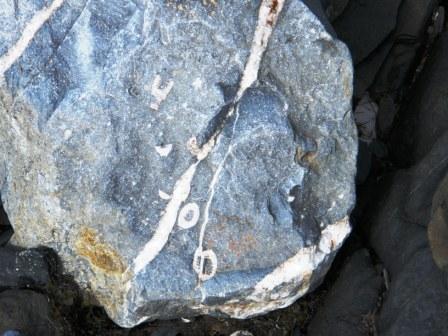
The morning was spent beach-combing and fossil hunting on Lindisfarne, then a boat out to the outer Farnes. The fossils looked like crinoids and belemnites and they were scattered all over the shingle and shoreline rocks


Fossils

The grandsons weren’t much interested in Saint Cuthbert or the ecclesiastical ruins except as a site for impromptu hide and seek. The trip on the boat was another matter, especially the fast outward journey with a massive bow wave and wash.
This late in the year, most of the puffins had left to resume their pelagic existence with only a few juveniles remaining and the terns had begun their marathon journey to winter, or summer, in the Antarctic. There were kittiwakes and shags aplenty and a large number of gannets displaying their diving skills.
For the boys the highlight had to be the grey seals, waiting for the breeding season to begin around about October and immensely curious regarding the boat, though they must be used to gawping tourists by now Seals


A flock of golden plover, more than a hundred strong flew in to land on one of the smaller islands, some were still wearing their striking summer plumage of black and white “waistcoat “ standing out from the gold back and wings but many had assumed their dowdier winter look.


The islands are the furthest fingers of the Great Whin Sill, the hard rock splits into columns like a miniature Giants Causeway, the cause of many a shipwreck, but we made it safely back to Seahouses. Ice-creams and doughnuts in the sun let us feel we could hang on to the summer holidays for just a little longer


Kittiwakes on columns

Summer’s lease hath all too short a date.!