Sunday, 5 September 2010

Cross my heart, it's true

The weather being fine, LotH and I went off to have a look at a large but anomalous earthwork in the neighbouring county. Chesters is in East Lothian and, like so many similar places, it gets its name from castra - a camp- a reference to the large imposing fort like structure with its concentric walls to be found nearby.


The only odd aspect to the place is that as a defensive redoubt it woud have been useless as it is closely overlooked by a higher hill from where it would have been easy to lob missiles over the walls


Not very easily defended !

The explanation given on the information board is that it was built during the Romano-British period by the local tribe who were allies of the Romans and didn’t need it for defence so it was purely for prestige. This doesn’t sound right. If one was looking to build a site to show off wealth or social standing, it would still be built on the highest point.

Looking at the view across the flat fertile Lothian fields to the sea which is due east and where the sunrise would be very obvious with Berwick Law, that conical volcanic mount, acting as a marker, I wondered if it had been an older pagan religious site which had been taken over by the Otadini who were probably Christian in the Roman period.
Whatever the reason, it is an impressive monument.

The nearest village is Athelstaneford where, according to legend, a combined army of Picts and Scots of Alba defeated the Anglo-Saxons of Northumbria and secured the Lothians for the embryonic nation that was to become Scotland. Apparently Oengus, the Pictish king of Alba, had seen a symbol of the St Andrew’s cross in the sky and vowed that if he achieved victory he would adopt is his nation’s symbol.


A view across the battle site to Berwick Law

There is a heritage centre in a 16th century doocot behind the village church overlooking the battle field.
The doocot

Lo and behold, as we climbed to the top of Chesters, two vapour trails formed a X- shaped cross in the sky.


Perfect timing or what.

Wednesday, 1 September 2010

Young and old come forth to play, on a sunshine holiday

I picked my first bramble of the year and the hedgerow goosegogs and wild rasps are well ripened. There is no doubt we are moving into the “season of mists and mellow fruitfulness”. Fortunately the “maturing sun” has also been in attendance so we took a day out to introduce the grandchildren to our own local version of the Galalpagos….the Farne Islands.


Castles had been the theme of the holiday with Alnwick Castle doubling as Hogwarts and Edinburgh with the one o'clock gun making everyone jump. The little castle on Holy Island was much more Enid Blyton ...A children's sized castle.

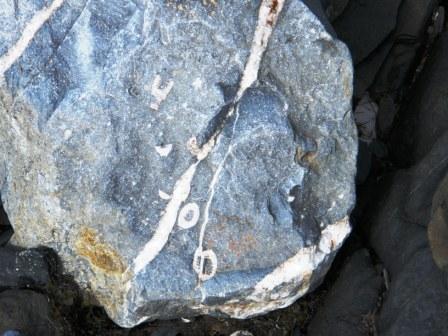
The morning was spent beach-combing and fossil hunting on Lindisfarne, then a boat out to the outer Farnes. The fossils looked like crinoids and belemnites and they were scattered all over the shingle and shoreline rocks


Fossils

The grandsons weren’t much interested in Saint Cuthbert or the ecclesiastical ruins except as a site for impromptu hide and seek. The trip on the boat was another matter, especially the fast outward journey with a massive bow wave and wash.
This late in the year, most of the puffins had left to resume their pelagic existence with only a few juveniles remaining and the terns had begun their marathon journey to winter, or summer, in the Antarctic. There were kittiwakes and shags aplenty and a large number of gannets displaying their diving skills.
For the boys the highlight had to be the grey seals, waiting for the breeding season to begin around about October and immensely curious regarding the boat, though they must be used to gawping tourists by now Seals


A flock of golden plover, more than a hundred strong flew in to land on one of the smaller islands, some were still wearing their striking summer plumage of black and white “waistcoat “ standing out from the gold back and wings but many had assumed their dowdier winter look.


The islands are the furthest fingers of the Great Whin Sill, the hard rock splits into columns like a miniature Giants Causeway, the cause of many a shipwreck, but we made it safely back to Seahouses. Ice-creams and doughnuts in the sun let us feel we could hang on to the summer holidays for just a little longer


Kittiwakes on columns

Summer’s lease hath all too short a date.!

Monday, 9 August 2010

The young ones

The summer is passing before we’ve had time to grasp it. It’s like chasing a butterfly. It is moving faster than you think. The winter barley has been cut though the spring sowing is yet to ripen. Apparently the yields are very poor after the dry, cold start to the year It has meant that NCC has had a brief access to the stubble fields before they are ploughed, harrowed and seeded once more. She has had great fun flushing up families of partridge, the young ones now being quite capable of flying away from her clumsy blunderings into the headrigs
The haws are just starting to blush pink and the geans are hanging with cherries that no-one but me seems to pick. The butterflies are out in force.


Green veined white

The young buzzard has fledged and the adults seem to have moved on but the youngster …I’m sure it is the young one… has stayed close to the nest, plaintively pee-youing, presumably in the hope of a meal. It’s not just human offspring that are unsure of making their way in the world.

LotH was intrigued at the sight of a queen red-tailed bumble bee being fertilised by a drone just at the patio door. He will die and she will look for a nest site to hibernate until the spring.


She would have been less intrigued by the elephant hawk moth caterpillar that I found on some common willow herb. Three inches long with fearsome eye spots, he was the stuff of creepy crawly nightmares though his parents are really elegant.

Funny how the most unprepossessing of youngsters improve with age.


Elephant hawk moth caterpillar

My collection of attractive, minor cascades continues to grow with the addition of the Corbie Linn – literally, the waterfall of the crows - and crows there were, cawing away in the surrounding woods. The Corbie Linn
It was worth a stumble and nearly a headlong drop to get a picture. Luckily I escaped with a few scratches and slightly bent specs.
A timely reminder that my young days of agility are long past.


Sunday, 18 July 2010

With a hey ho, the wind and the rain,the rain it raineth every day

Swithin’s day, if thou dost rain,
For forty days it will remain
St Swithin’s day, if thou be fair,
For forty days ‘twill rain nae mair


St Swithin’s day has come and gone and, indeed, it did rain so are we due a long wet summer? The rain was certainly needed by the farmers but the prospect of more just as the harvest approaches cannot be anticipated with much delight. To be honest, the weather is never quite right for the agricultural community. What pleases the stockmen isn’t the best for the grain growers and what suits the tattie growers isn’t just perfect for the rest.


Ripening fields


Our annual pilgrimage to the Atlantic’s edge, the Isle of Lewis trip, featured wind and rain that, even by Hebridean standards, was dreadful. You don’t expect to need factor 30, but to be confined to quarters with paper backs and crosswords in July was a bit frustrating. The St Kilda trip was cancelled and even quick local forays resulted in soakings however we did manage a few jaunts so that LotH could recharge her Gaelic batteries.

On one trip to the west side of the island, we stopped at the Norse Mill in Shawbost, having driven past it scores of times before. A restoration of an old mill of the kind that was common throughout the islands right up into the 20th century with a horizontal water wheel rather than the more familiar vertical one. the design must date back to the Iron Age. A companion building housed a simple grain drying kiln heated by a peat fire so it would seem that the farmers had problems drying their crop right back to the days of old Saint Swithin himself. Of course, they didn’t have to meet the demands of the grain buyers on moisture content or pay for diesel but I bet they grumbled just as much.


Shawbost Norse Mill


Interior of mill


http://www.undiscoveredscotland.co.uk/lewis/norsemill/index.html

Heading home with a haul of famous Stornoway black puddings and duff (dumplings, to the uninitiated) we were lucky that the North Atlantic low had moved on taking its gales with it and allowing for a reasonable crossing of the Minch.

NCC was ecstatic to have her walks reinstated, throwing herself around and rolling over with joy. A couple of long walks seemed poor recompense for such a welcome and despite the prediction in the rhyme the rain has held off for the time being.
The wild flowers are, by and large, beginning to set seed though the almond scent of the meadowsweet is still a pleasant background to our tours of village.

The swallows seem fewer this year and I have not seen a swift at all. Only two last year and none this year. Sad. The scream of the devil birds round the houses was always part of village summers. I remember picking up a young swiftlet that had landed on the ground and couldn’t get airborne again with its long wings and short legs. Place it on top of a bay window for take off and off it went. What has happened to the swifts? Cousin in Florence tells me there are dozens there. Lack of nest sites as all the old buildings get tarted up?
Perhaps the planners could make it a condition of consent that nest sites are included. I doubt it.. If they don’t return, I’ll miss them because if ever a bird lived up to its name – blackbirds are black birds: ducks do duck: fly-catchers catch flies: wagtails do wag their tails and swifts are gloriously, wondrously swift.

As Ted Hughes says in his poem Swifts, about their return

They’ve made it again,
Which means the globe’s still working,


A more perceptive observation than old St Swithin’s rhyme ever was... and all the more ominous when no swifts are seen.

Tuesday, 22 June 2010

Grey, white and blue

The Grey Mare's Tail

Eight months since I got my new hip, time for some field trials. With no unclimbed Munros near at hand, I settled for a Corbett (2500 to 3000 ft.). After last week’s foray up the Yarrow valley, it seemed natural to venture just a wee bit further over the watershed into Moffatdale to White Coomb. Roadside car parking, courtesy of the National Trust and a well maintained, if fairly steep, path up the side of the Grey Mare’s Tail waterfall was a easy start to the climb. Sun hat, sunscreen, plenty of fluids – gone are the days when you could happily drink from hill burns - a fleece, for despite the sunny day, the temperature at the top might be a lot less, and off I set.
Up the long “staircase” to the top of the falls then further up to Loch Skene sitting in its little valley below Lochcraighead . Itself no mean hill at over two thousand feet. – a so-called Donald after Donald’s lists of lowland hills of this height,- it lowered over the loch.
Halfway up, a hawk cried from a high crag but was too far off to identify, possibly a merlin. I had seen one in a neighbouring valley previously.


Lochcraighead looms over Loch Skene while a couple of feral goats pay me no attention

Lochcraighead proved a bit of a challenge on the old legs but once the summit was reached, the ridge out to White Coomb looked a nice stroll following the county boundary fence. Ah, the county boundary – a face saver, indeed, maybe even a life saver, in the days before GPS navigational aids. Lost in the mist – find the boundary fence and you knew where you were on the map. Follow it and you would get to somewhere else on the map without risk.


The boundary wall and fence !

White Coomb provided the greatest of views. To the east the Eildons and the Lammermuirs: to the north the Pentlands and the southern edge of the Grampians : west to the Manor hills : south to the Cheviots, then over to the Lowthers and, hanging in the haze, the Lakeland fells.

White Coomb from Loch Skene

Going up had been strenuous enough but, oh, coming down was hard on the old joints. Plenty of stops gave me time to admire the carpet of wild flowers. Yellow stars of tormentil, the deep blue of milkworts, the tufts of bog cotton, northern orchids, and masses of dwarf cornel. Apparently, its berries are an appetite stimulant which gives it its Gaelic name lus a chraois – plant of gluttony. I would have thought climbing two thousand feet would have been enough of a stimulant without any berries.


Dwarf cornel


Down at car-park level, there was time for an expedition up to Dobb’s Linn to look for fossils. The fossils are easily found amongst the oil shale rocks -Ordivician graptolites, like little doodles on the slatey shale.
Dobb's Linn
The most pleasing find was the linn itself, a delightful little three-stage fall, much prettier than its big blowsy hyped up neighbour down the road.
So the new pin stood up to a bit of off-roading. Well done, the orthopods !


The blue remembered hills ...............where I went but cannot come again

but now I can, thanks to the skill of the orthopaedic surgeons and the marvels of technology. I am very thankful.


Wednesday, 9 June 2010

Black magic and bread & butter pudding

Monument to James Hogg near Tibbie Sheil's Inn

Reading James Hogg’s The Brownie of Bodsbeck with its setting in the Border valleys where Ettrick and Yarrow almost meet, we felt a trip to Tibbie Sheils Inn at the head of St Mary’s Loch and erstwhile convivial haunt of Hogg and Scott and the literarati of Edinburgh, was in order. By happy coincidence Tibbie Sheils turned up in the Times list of 50 Best Places to eat in Britain. It seemed like a good omen.
It also gave me a chance to go and look for the site of Binram’s Corse, corse being Old Scots for cross. It was common for the r to be transposed as in brunt for burnt or girse for grass.
According to tradition and to Hogg’s poem, Mess John, Binram was a priest at the nearby Kirk o’ the Forest who was so obsessed by “the bonnie lass o’ Craigieburn” that he raised the devil in order to bring her under his power and seduce her. He was shot and killed by Covenanters and his grave is still to be seen though the cross has long since gone.

After the success of my play with its hero, the grave-robbing Dr Laurie, a necromancer priest might just prove a source of further inspiration and there was the prospect of a pleasant meal in literary surroundings to boot.
Journeying up Yarrow is a trip into historical romance. _ the Dowie Dens of Yarrow. The characters appear from all sides Mungo Park the explorer of the Niger: Sir James Douglas, Bruce’s lieutenant, - the Black Douglas to the English, the Good Sir James to the Scots: Mary of Dryhope, the Flower of Yarrow: Hangingshaw, the home of the Outlaw Murray: Newark Tower, hunting seat of Scottish kings and setting for Scott’s Lay of the Last Minstrel: the Brakehope Burn, scene of the ballad The Douglas Tragedy with its tale of eloping lovers and pursuing brothers, duels and death.
What a river!
Tibbie’s proved as good as expected - simple food, excellently prepared, using local produce, a good Sunday roast beef and two veg. with a suitably comforting bread and butter pudding to follow, though LotH declined the latter.

After lunch, I wished I had taken the same firm stand as I puffed up the footpath looking for Binram’s grave.


Binram's Corse overlooking St Mary's loch and Bowerhope, once home to James Hogg

After my misadventures in the mist on Hart Fell (Blog 27/03/2007) when some rather dodgy compass work had resulted in my ending up in the wrong valley, the girls, fearing for my safety had bought me a GPS navigation aid, so it was easy-peasy finding the site using the RCAHMS co-ordinates..
A lonely spot made even more desolate by the mournful calls of the whaups, - curlews to English speakers. Binram's Corse, a lonely spot


Mission accomplished. Home to re-read Confessions of a Justified Sinner, Hogg’s great master work.

Monday, 7 June 2010

Ospreys and Eye-ops


A trip up north to Carrbridge was just the way to take advantage of the recent sunny spell. A chance to watch the famous Boat of Garten ospreys and search for the elusive Scottish crossbill, our only truly indigenous bird. It’s a sair reflection on our delusions of Braveheart grandeur when we realise that our truly native species, found nowhere else, is not the majestic golden eagle but a dumpy wee finch with a beak like a pair of secateurs.


Male osprey leaving after bringing fish

The crossbills proved too elusive. It would seem the long harsh winter has diminished their numbers, but we did spot golden-eye on Loch Mallachie and Slavonian grebes on Loch Ruthven, six breeding pairs alongside red-throated divers and the dotterel on Cairngorm.


The Clootie Well


A trip to Cromarty in search of the dolphins ended up in Raigmore hospital. We had gone by way of the Clootie Well, an ancient site where people have left bits of clothing as part of an old belief that as the cloth decomposes the ailment from that part of the body will also go.
Two hours later, I was in the Eye department with a vitreous detachment and a retinal tear getting lasered. The influence of the Clootie Well is obviously not pro-active.

LotH has become an osprey fan and has been watching the hatching and the rearing of the three chicks via the web-cam.

http://www.rspb.org.uk/webcams/birdsofprey/lochgartenospreynest.asp

The last and smallest chick’s battles to get a share of the food are fascinating to watch. To raise three young is a huge achievement. but the pair did manage it last year and the male bird seems a great provider so here’s hoping for a similar success this time.

A trip to feed the Cairngorm reindeer was fun but an even easier way to watch wildlife is to go to Inshriach gardens and sit and eat cake while watching the squirrels. If only all nature was so accessible


!!!!