Sunday, 10 January 2016

...winter and rough weather


Sunrise on the winter solstice !
The winter solstice was a washout. Sunrise over the sea looked like matt paint shade card...for shades of blue- grey.

The view to the horizon looked like Rothko painting


 There was a full moon on Christmas Eve and Aurora Borealis on Hogmanay but apart from these highlights it has been an unremittingly dreich month.
Luckily the downpours held off for the New year's day dip in the sea, a custom inaugurated by a few of us some years..come to think of it, some decades... ago which has grown in popularity.


Flooding hasn't been the problem here possibly because the winds have been from the south west. It is when the wind is easterly that the sea unleashes its full fury on the sea wall

The harbour was filled with foamy spume which covered boats and gear and blew over the quayside.


The relatively mild winter has kept the more unusual visitors away from the bird feeder, the woodpecker and nuthatch have only paid the briefest of visits and the long-tailed tits, goldfinches and black-caps haven't been seen. We are hoping it is the availability of food in the countryside that is allowing them to stay away. They only visit in severe weather giving the garden birds, the tits, sparrows, robins and wrens the run of the feeders when they can find food else where. The blackies have pecked their way through all the windfall apples from the eating varieties and are now started on the cookers. Presumably, they prefer the former for the higher sugar content but they obviously have a sweet tooth just like us or at least a sweet beak. One shouldn't attribute such characteristics to wild creatures but they do always go for the eaters first!
Strange weather, seasons out of kilter, makes for odd happenings. The daffodils we planted along the verges to make a golden gateway to the village are starting to bloom, The aconites are in flower at the same time as the Lenten roses. The pot marigolds are showing their sunny faces alongside the winter flowering jasmine...the only sun we've see this year.
The world seems topsy-turvy and that's without the elections and referenda to come this year.
2016 looks to be an interesting year.
There is an old curse... May you live in interesting times !
We shall see.

Friday, 27 November 2015

The blush of dawn.


I don't like the dark days of winter. Rising in darkness always seems like a chore but to be abroad before dawn has its compensations.    The world is stirring and stealing a march on it makes me feel  virtuous.
 Yesterday's walk for the newspapers was lit by a moon just past the full. The moon before Yule, to give it its title. The next full moon will be The Moon after Yule, then the Wolf Moon, then the Lenten Moon and so on.
Up in the western sky, at the anti-solar point, opposite where the sunrise would be, was a pinkish glow.
I wondered if this was the so called Belt of Venus, a rosy pinkish arch visible after sunset or before sunrise, caused by back scattering of refracted sunlight from fine dust particles high in the atmosphere.     Sometimes there is a dark band below it caused by the Earth's own shadow but this morning the horizon was obscured by cloud


Hop into the car and up on to the moors to check against the western sky and ..yes.. I think it was...
the pink band across the sky opposite the  not-yet-arrived  sunrise.... the  moon setting over the Belt of Venus.
 Dark days have their light side.

Monday, 23 November 2015

Willow weep no more


According to the financial pages, there is a housing shortage in the UK. People are desperate to get on the property ladder and have created a dearth of available property.

The problem has come closer to home. The blue tits are homeless. They will have to migrate to the other side of the garden and compete with the tree sparrows and coal tits for accommodation.
The storm winds have brought down the willow, the pussy willow  the goat willow, Salix caprea,  at the bottom of the garden and with it both the nesting box still attached to its stout trunk and the one in its upper branches.
The tree was a measure of our time in this house. In the spring of the first year, the garden was full of daffodils. Grandmother, on a tour-of-inspection visit, picked some and acquired, as was her wont, from goodness knows who or where, some pussy willow twigs, and made up a simple arrangement.
There wasn't a willow tree anywhere near our house.
When the daffs faded and were on their way to the newly established compost heap, I noticed little rootlets on three of the willow stems and thinking they deserved a chance, stuck them into the ground by the garden wall. They flourished and grew into a tall tree which still showed the three trunks corresponding to the three original stems. Pruning and loppings over the years as it spread its shade had reduced its grandeur to a single trunk.
Now its gone. It will be trimmed and sawn up in to logs that will heat us just as it once shaded us.
The bird boxes can be saved and relocated but no sites are as suitable as the old willow where the comings and goings of the parent birds and the fledglings first appearance and tentative flights could be observed, without their disturbance, from the dining room.
We have lived in this house longer than the life of a tree, children and grandchildren have been intrigued by the furry catkins, bees have relished an early drink of nectar in the cold days of early Spring, pigeons have balanced the rickle of twigs they call a nest among it branches and the sparrow hawk has perched there, camouflaged against its grey bark.
The willow will be missed and not just by us.


Winter Warmth


Monday, 5 October 2015

The Hidden Valley


I've been to Glen Coe many times, climbing, walking or just passing through en route to another bit of the Highlands but for some reason I've never climbed up to the Hidden Valley. It was always a case of " the next time"... too short an excursion for a single trip but a bit much to tack on to a Munro-bash. I began to realise that it had to be soon or I wasn't ever going to mange up the track by the stream, Allt Coire Gabhail, to the Valley of the Booty, the reputed hiding place of the MacDonalds of Glencoe for stolen cattle and a place of refuge at the time of the Massacre ( Blog 01/04/2015)

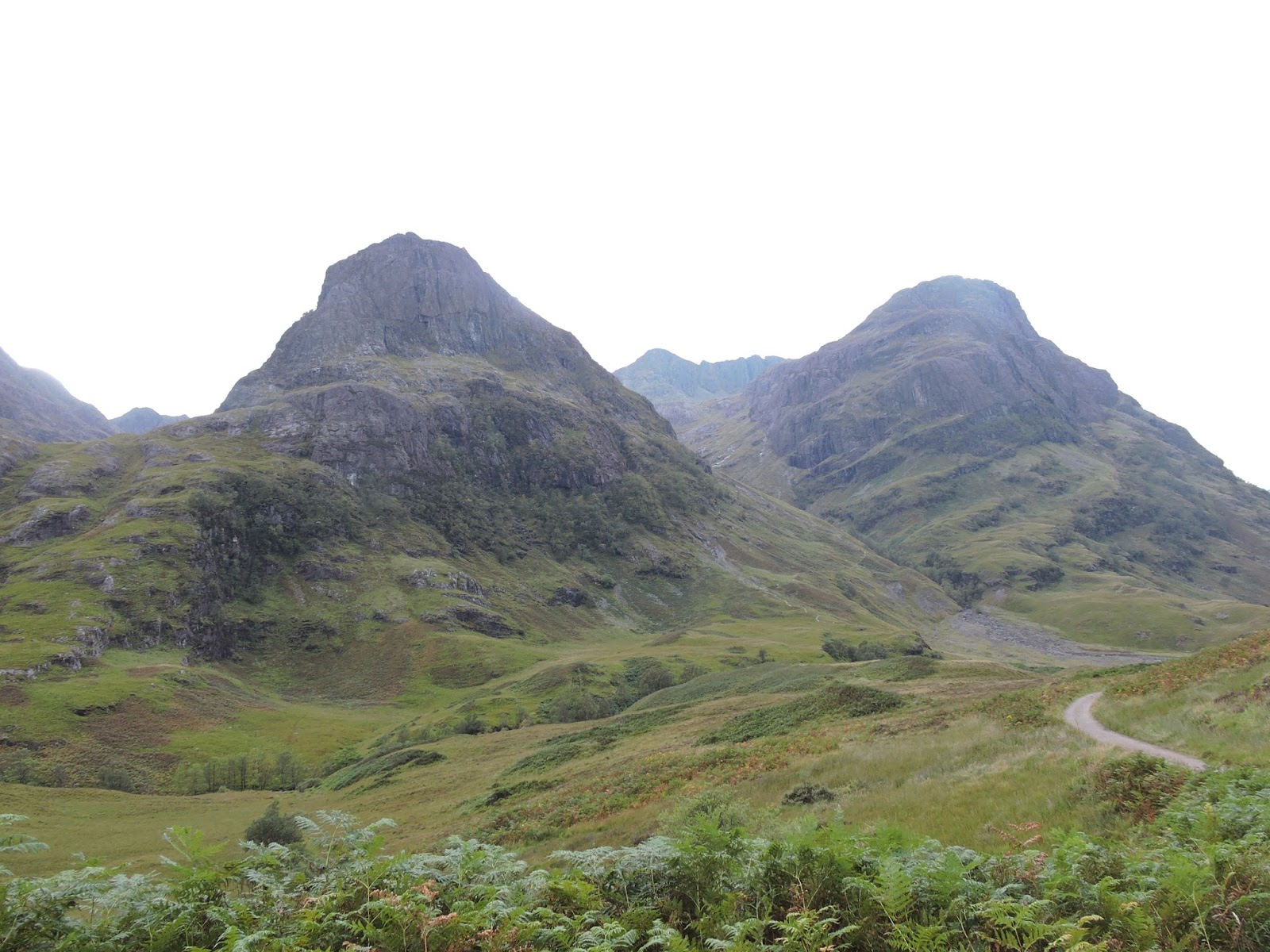
Coire Gabhail betwen Beann Fhada and Gearr Aonach

Coire Gabhail (Corrie of the Plunder) is a high level glen in the Bidean nam Bian massif to the south of Glen Coe. Invisible from the  main glen, it is accessed by a track up the side of the ravine that carries the allt or stream to the Meeting of the Three Waters on the River Coe. The track rises between Beinn Fhada and Gearr Aonach, two of the "Three Sisters" on the south side of Glen Coe. 

The third of the trio is Aonach Dubh, the Black Ridge.where lies Ossian's Cave, a site that is a bit too inaccessible for me nowadays. 
 Gearr Aonach and Aonach Dubh with part of the old military road
 
Ossian was the mythological poet, son of Fingal - also with a cave named after him- whose works were made famous and almost certainly made up by James Macpherson in the nineteenth century. Despite their forgery they were part of the image of Scotland and Scottishness that still survives to this day
Beinn Fhada (Long Hill) is the easternmost sister, and the central sister Gearr Aonach (Short Ridge) on the right of the hidden valley forms its western side.
Crossing the river, the land around the stream is surrounded by a deer-proof fence, allowing regeneration of woodland, mainly birch, rowan and hazel. The project was started in 1983 and gives an idea what the Highlands would look like without deer and sheep. It would be great if it could be extended to encompass more of the barren sheep bitten hillsides.

The path is well constructed with stone steps in places but still needs a fair bit of scrambling and a bit of hands on climbing over rocky outcrops. Just how the MacDonalds ever got a herd of cattle up to the valley was beyond me.


The cascading waterfalls feeding into the burn made a wonderful background to the walk and the waters in the pools were unbelievably clear.


Ferns and wild flowers freed from the mowing of the sheep were abundant...sheepsbit scabious, self heal and the tiny golden stars of tormentil. 


After surmounting the last sloping rock...not something I would like to try in the rain.. the top of the path was in sight and not, as often happens on the hills, a false summit. No, we had truly reached the top. A few more steps and the lost valley spread out before us. The great cliff of Gearr Aonach forms the west side and the slopes of Beinn Fhada, the east. Ahead was the massive Stob Coire Sgreamhach. 

The valley appears with Stob Coire Sgreamhach in the distance
 
The Hidden Valley


Sitting on the slope down into the valley, replenishing the energy stores, we could hear the red deer stags bellowing as the annual rut started. The sound echoed off the walls of the glen, challenging all, asserting the dominance of the herd leader.

The descent a bit trickier going down the rocky bits than coming up but accomplished without injury or indignity then back across the bridge to the old military road, General Wade's road, by which the Hanoverian government sought to subdue the Highlands after Culloden.
Built to let troops move easily around from their bases at Forts William, Augustus and George, the new roads provide an economic boon the people of the area allowing transport of cattle and goods to improve and eliminate the need for hidden pastures.
A good day out before the chill of winter and another tick on the list.

Tuesday, 29 September 2015

Pink moons and dark age bloggers


We all gathered in the Glebe field, the field that, in the past, provided grazing for the minister's horse. Amateur metal detector users under the guidance of a few experts. Why? Well, not to hunt for treasure, though everyone must have had a frisson of excitement as the detectors pinged a high note indicating something other than iron.
It was part of the continuing search for the site of the Anglo-Saxon church or monastery founded by Ebba, later Saint Ebba, sister of Oswy and Oswald, Anglo-Saxon kings of Northumbria.

The geophysical survey revealed interesting shapes beneath the surface of the field and dowsing seemed to agree with it.
The next stage would be a dig but, to get a grant for such a venture, community involvement had to be demonstrated hence the turn out for the metal detecting. Any finds that supported the theory would also be useful.


Some coins and a few buckles and artefacts were found, some of them medieval though nothing dramatic. My contribution was woeful - two aluminium cans and the iron bolt from a Victorian iron.
A .303 cartridge case and the copper ring from a canvas tent were reminders of the use of the field as a camp site for local Volunteers of the same vintage as my iron bolt and a toy gun that boys of all ages like to play soldiers.


The next night was spent watching the lunar eclipse and the pink moon. An event that won't occur again in my life time.


The Chronicon Scotorum and the Anglo Saxon Chronicle are really just Dark Age blogs with facts and opinions mixed in with speculation and rumours.
The Chronicum is an extensive list of battles and skirmishes as the Irish settlers -the Scotti - sought to establish their kingdom in Dal Riata and fought with the Britons, the Picts, the Cruithne as they would have called themselves, or sometimes amongst themselves for dominance as the early Irish church tried to establish its form of Christianity among the pagan tribes. The whole record is interspersed with Druidic bardic verse -

Cold is the wind across Ile
Which blows against the youth of Cenn-tire;
They will commit a cruel deed in consequence;
They will kill Mongan, son of Fiachna.
Cormac caem and Illand son of Fiachu die.Ronan, son of Tuathal died:—
The church of Cluain-Airthir to-day—
Illustrious the four on whom it closed:
Cormac the mild, who submitted to tribulations,
And Illann, son of Fiacha.
And the other pair,
To whom many territories were obedient—
Mongan, son of Fiachna Lurgan,
And Ronan, son of Tuathal.

Straight out of Lord of the Rings or Game of Thrones or not?

There are occasional allusions to contemporary events other than the violent deaths of chieftains and their followers in what was the heroic age of warriors now so popular in fantasy games and films.
References are made to plagues and pestilences, to leprosy and the murrain of cattle and, to sadly evocative phrases such as" the mortality of children" - no doubt some childhood infection such as diphtheria or scarlet fever that continued to play sad havoc up until immunisation.


Ecclesiastical records such as the death of St Patrick in 489, the birth Colum Cille ( Columba) in 518 and his arrival on Iona in 563 A.D. and the apoointments and deaths of long forgotten bishops and abbots, are interspersed with increasing references to "the Saxons", obviously becoming a greater power as the might of Northumbria increased, but not a word about Ebba even a though her protector in her exile, Eochaid Bruie, is mentioned as is Bede
 Is that because St Ebba was not part of the Columban church , an Anglo-Saxon? She was the daughter of a king and the sister of two others...  yet no mention.

The weather is reported in almost mundane terms - the sea floods of 720 when there was " a rainy summer". How many of those have we had since then?

Celestial events, however, bring out the poet in the chronicler -

A thin and tremulous cloud in the shape of a rainbow appeared at the fourth vigil of night on the fifth feria preceding Easter, extending from east to west through a clear sky.
The moon became the colour of blood
Annal 674 AD

"The moon was as though drenched with blood."
 Simeon of Durham.
Refers to a lunar eclipse of 23 November AD 755, when the eclipsed Moon occulted Jupiter.


An Anglo-Saxon Chronicle records that on January 24, 734 CE, "the Moon was as if it had been sprinkled with blood"


Times may change and we live in a scientific age and explanations of such phenomena are available to all. We no longer see them as portents or omens but they still imbue us with a feeling of wonder sufficient to get us out of bed to witness them for ourselves.
The monks and nuns the Anglo-Saxon community in what is now the glebe field would have been amazed like us to see the colour of the moon change as it was eclipsed. Times change but people don't and the celestial cycle certainly doesn't.

Sunday, 13 September 2015

Before dawn o' day


We've all known some false dawns when hopes weren't quite realised. They happen more often than we would wish for, certainly more often than once in a blue moon.

There was a blue moon in July this year. An extra full moon. thirteen in the year instead of the usual twelve. All full moons have names ... Harvest Moon, Lenten Moon, the Moon before Yule and so on, so every extra moon has no name but is a blue moon though it's never really blue. Why it's called this isn't really known though there have been some fanciful explanations dating back to the Middle Ages.
The next blue moon will be in 2018.


Not blue


False dawns are easier to see. They occur about an hour before the true sunrise. Many folk will have seen them without realising where the light was coming from, especially at this time of year when people are on the move before the sun is up.
Zodiacal light – or false dawn – is an eerie light extending up from the eastern horizon, before sunrise, in autumn. The light looks like a hazy pyramid of light extending up from the horizon.
Zodiacal light is caused not by the dust in the Earth's atmosphere that causes the colours of the true sunrise or sunset but by space dust .... the zodiacal cloud, a pancake shaped dust cloud out in the solar system. If the night is really dark, no moonlight.. or very little and a cloudless sky, you can see it on the eastern horizon an hour before the true dawn.. 5 a.m. Sleepy-eyed, I had a go. Unfortunately, clouds obscured most of it but it was there -  an eerie light on the eastern horizon, a good hour before the dawn.


A false dawn  more than an hour before sunrise

Red false dawn

Check it out next time you are on the move early. There is an equivalent false dusk in the spring about an hour after sunset.


The light was still there as the clouds parted an hour before sunrise


"The moon was low down and there was a glimmer of the false dawn that comes about an hour before the real one, but the light was very faint..."

Rudyard Kipling - False Dawn

Sunday, 6 September 2015

Going Forth


The Hawes Inn has been the starting point of one literary journey in Scott's The Antiquary and a way-point in another, Stevenson's Kidnapped and so it was that we continued in the tradition, starting our little journey down the Forth from Hawes Pier. 
 Fortified with good coffee and a shared oat flapjack, we boarded the Maid of the Forth for our three hour voyage under the bridges, down the firth and down the ages to Inchcolm.


Sailing out under the iconic red structure that is the Forth Bridge, deservedly a World Heritage Site, we gave a thought to those that died in its construction before clearing its shadow and out past the oil terminals towards Inchcolm, - Columba's Isle. -Saint Colmes ynch as Shakespeare would have it.

Originally a Culdee hermit's cell, like its near neighbour Inchmickery, the solitude sought by its sole inhabitant was interrupted by the arrival of King Alexander I, storm bound as he crossed the firth in 1123. His gratitude was such that he established an Augustinian monastery on the island probably the last thing that the Culdee hermit wanted to see, but was in keeping with the royal house of Canmore's promotion of the hierarchical Roman church over the Celtic Columban church throughout their domain.
Despite the attacks of English and Danes, the Scottish religious wars, and being close to the first bombing raid of WWII, it remains the best preserved of Scotland's medieval religious houses.


Cormorant colony


The puffins had left by the time of our trip but the stiff winged fulmars still skimmed the waves and the reptilian eyed herring gulls screamed their raucous threats as we made our way to the island past the cormorant colony on the Haystack, one its rocky outliers.
The abbey has an immediate impact set above a little cove that allows landing access.


A short walk takes you to the buildings and the little hermit's cell or oratory that survives in the grounds of its prestigious successor. We were given a conducted tour and potted history by one of the Augustinian brothers. The chapter-house, cloisters, dormitory, refectory and calefactory or warming-room gave a glimpse of what our own local priory would have looked like before Cromwell's depredations. A few sentences in medieval Latin still adorn a wall. Amongst them, the advice that it is -
Foolish to fear what cannot be avoided


A hog-backed gravestone, typical of Norse burials, was a reminder of the importance of the island as a burial site for chiefs making it the "Iona of the East"
In Shakespeare's Macbeth, Ross, reporting to King Duncan of Macbeth's defeat of the Norwegian invaders, tells of the Norse king, Sweno wishing to bury his dead at Saint Colmes-inch and paying "ten thousand dollars"for the privilege.

Shakespeare's dollars are an anachronism for Macbeth but the term occurs again in The Tempest. Perhaps W.S. meant dalers, Scandinavian coins he would have known about.

Our guide mentioned that the second part of the early Scottish history, the Scotichronicon, started by John of Fordoun in the 14th century, was completed by the abbot, Walter Bower in 15th at Inchcolm.

Sir Walter Scott, Robert Louis Stevenson, William Shakespeare, and now a medieval historian compiling "probably the most important medieval account of early Scottish history", Inchcolm has made its contribution to literature as well as history.


With heads teeming with dates and facts, we boarded the Maid of the Forth for the return trip to South Queensferry and watched the seals lazing on gas pipe-line installations and navigation buoys. What do they care about words and histories as long as there are plenty fish in the sea.

A rainbow bridge between the bridges